Growth changes label purchasing quickly. Philiton organizes manufacturing around SKU structure, reorder frequency, visual consistency, production method, inventory exposure, supplier continuity, and the next volume stage rather than isolated print jobs.
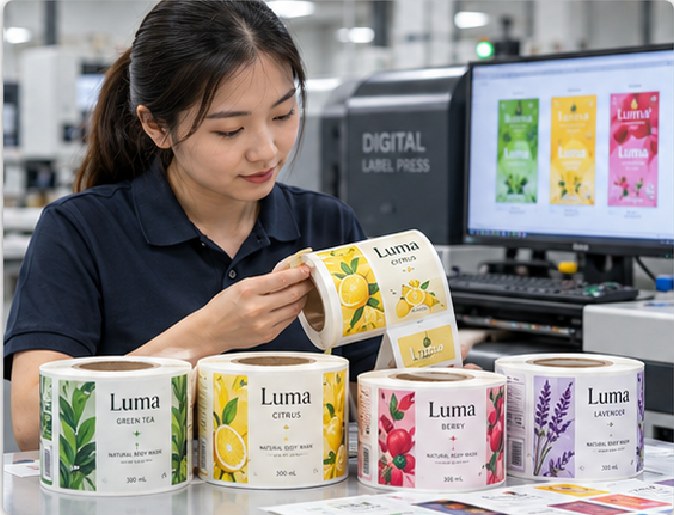
Early sales often create an uneven SKU mix: several strong products reorder quickly while slower variants still need smaller replenishment. Philiton can keep compatible SKUs on shared material and technical platforms while controlling each artwork separately. Digital production helps reduce unnecessary setup during early growth; higher-volume winners can later be reviewed for flexographic production. The goal is to protect cash, avoid obsolete packaging, and keep expansion from turning into a new supplier search every season.
A ten-SKU order is not the same as one large single-SKU order. Each version needs approved artwork, quantity control, color review, identification during QC, and correct roll or carton marking. Philiton manages multi-SKU programs by separating artwork control from shared manufacturing variables such as face stock, adhesive, size, core, roll direction, and finishing. Standardizing what can be shared reduces changeovers while preserving clear version control for flavors, scents, sizes, languages, regional packs, or retailer-specific designs.
Online print platforms work well when specifications are simple, but growing programs often add adhesive questions, automatic application requirements, Pantone-sensitive colors, specialty finishing, variable data, or larger recurring volumes. Philiton adds engineering review before production and can move beyond upload-and-print ordering. Material, adhesive, print route, die cutting, winding, inspection, and packing are treated as one manufacturing specification, giving procurement and packaging teams more control when labels become an operational component rather than a simple graphic.
Established brands also use flexible runs for regional launches, limited editions, line trials, packaging changes, and supplier qualification. A smaller pilot can lock artwork, material, adhesive, color target, die dimensions, roll direction, and packing rules before broader release. Philiton can support pilot quantities with the same engineering, prepress, converting, and quality disciplines used for larger programs. Once performance is approved, repeat orders can reuse retained specifications instead of restarting development from the beginning.
More sales rarely mean only “more labels.” SKU mix, artwork control, production economics, inventory exposure, packing requirements, replenishment speed, and repeatability all change as more teams depend on the same specification.
Growth usually brings new flavors, scents, pack sizes, languages, channel versions, or seasonal designs. If every variation becomes a separate material, size, adhesive, or finishing specification, complexity and setup cost rise quickly. Philiton looks for a common technical platform first: shared face stock, liner, adhesive, die size, winding, and packing where application permits. Artwork remains individually approved and traceable. A cleaner specification architecture makes later reorders easier to quote, schedule, inspect, and pack without hiding important differences between SKUs.
Launch orders may be occasional; successful products create recurring replenishment. Repeat production should not depend on someone remembering the previous settings. Philiton retains approved artwork, production specification, material route, tooling information, and reference requirements when applicable. Reorders are reviewed for changes in quantity, container, application, regulation, or finishing before release. Unchanged projects can avoid unnecessary redevelopment, while changed conditions are identified before production rather than after labels have already reached a filling or packing line.
Not every SKU grows at the same rate. A brand may have two hero products at 30,000 labels each and eight long-tail variants at 2,000 each. One printing method does not need to serve every version. Digital production can remain efficient for changing or lower-volume SKUs, while stable high-volume items can be compared with flexographic economics. Philiton evaluates quantity per SKU, artwork stability, color, material, finishing, and repeat frequency instead of forcing the whole portfolio into a single production route.
At higher reorder frequency, a small specification error can multiply across more rolls, cartons, filling locations, or markets. Artwork version, barcode data, label dimensions, adhesive, roll direction, core size, color target, and pack identification become procurement controls, not minor details. Philiton uses requirement intake, sample or trial approval where needed, production specifications, in-process inspection, final checks, and batch identification to reduce avoidable rework. Growth is supported by stronger control, not simply by running the press longer.
Philiton can keep one program moving while quantities, SKU mix, production economics, and replenishment needs change. The ranges below are planning guides, not fixed limits or guaranteed thresholds for every construction.
| Stage | Typical Order Structure | Recommended Production Focus | Control Priority | What Philiton Reviews |
|---|---|---|---|---|
| Concept / Sample | Material, print, adhesive or application sample | Material and process validation | Fit before volume | Artwork, substrate, surface, adhesive, finish, size, roll needs |
| Launch | About 500-5,000 pcs/SKU for many standard programs | Digital / short-run route | Limit inventory risk | SKU count, artwork readiness, material availability, finishing, delivery format |
| Growth | About 5,000-50,000+ pcs/SKU depending on specification | Digital, flexo, or mixed route | Cost and repeatability | Quantity per SKU, repeat frequency, color stability, tooling, shared specifications |
| Scale | 50,000-500,000+ pcs or recurring production programs | Flexographic / higher-volume workflow where suitable | Batch consistency | Approved specification, material control, press route, QC, packing and schedule |
| Strategic Supply | Repeated orders across months, regions, or product lines | Program management and replenishment planning | Continuity and change control | Forecasts, version changes, retained references, shipping rules, contingency options |
Philiton supports common packaging formats plus identification, security, and smart-label structures when growth adds new products, sales channels, packers, fulfillment routes, or operational requirements beyond visual branding alone.

Pressure-sensitive product labels can be supplied as rolls, sheets, or individual pieces according to manual or machine application. Paper and film constructions can be matched to surface, moisture, oil, abrasion, appearance, and lifecycle needs. Growing ranges benefit from shared material and size platforms where possible, especially when new variants must be added without rebuilding every technical field.
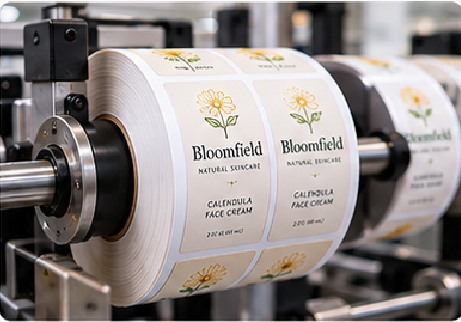
Roll labels suit hand dispensers, semi-automatic equipment, and automatic applicators. Core size, winding direction, label gap, pitch, liner, roll diameter, labels per roll, and splice rules may affect line performance. Philiton can build those variables into the released specification instead of treating roll format as packing only, reducing repeated setup questions on every reorder.

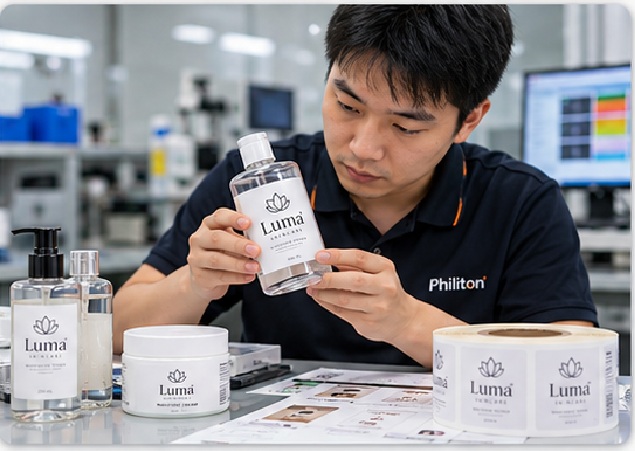
Bottle programs often require attention to curvature, squeeze, condensation, oil, refrigeration, or small diameters. Transparent, white film, paper, metallic, and decorated options can be considered, but adhesive and stiffness must suit the actual container. Physical bottle samples improve application review before volume production and help detect edge-lift, stiffness, or wrap issues before larger quantities are released.
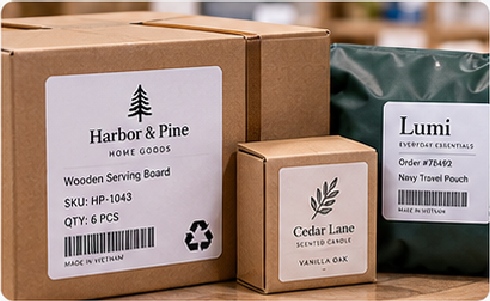
Cartons, pouches, jars, boxes, mailers, and retail packs may use decorative labels, seals, information labels, barcode labels, or promotional variants. Philiton can coordinate materials, print, finishing, die cutting, variable content, and pack identification across multiple SKUs while keeping approved artwork separated and clearly traceable through packing, shipment preparation, and later replenishment orders.

Tamper-evident, destructible, VOID, holographic, concealed-code, and serialized constructions can support brand protection or controlled access. Exact tamper behavior depends on surface and structure, so security programs require defined evidence goals, restricted artwork handling, sample validation, waste control, quantity reconciliation, and project-specific inspection before the structure is released for repeat production or broader distribution.
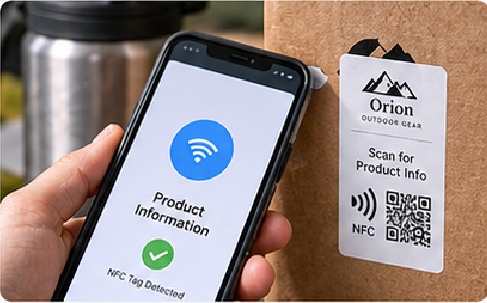
RFID/NFC-related labels can be developed where identification, tracking, authentication, or interaction is required. Inlay or chip selection, encoding rules, read/write verification, placement, materials, converting, and final application must be confirmed per project. Philiton handles manufacturing and verification within the agreed technical scope, while chip selection, data rules, encoding, and end-use performance remain project-specific decisions.
Material selection should be settled around real packaging conditions before a successful SKU turns into a larger, recurring label order with less room for trial-and-error, emergency substitutions, or application failures after launch.
Paper can be a strong fit for dry, standard packaging, textured branding, and cost-sensitive programs. Film structures such as BOPP/PP, PET, PE, clear film, white film, and synthetic stocks become important when moisture, oil, abrasion, transparency, outdoor exposure, or flexible containers enter the specification. A finish cannot compensate for a fundamentally unsuitable base material.
Philiton starts material review with the package and environment rather than a swatch book alone. The team looks at the container or substrate, storage conditions, expected handling, print coverage, desired finish, label geometry, and manual or automatic application. Clear labels may require white ink planning to preserve opacity and brand color. Uncoated or textured papers can change ink absorption, fine-line appearance, and foil performance. Films may need surface treatment or matched ink systems.
Growth makes these decisions more important because material changes after launch can alter color, stiffness, adhesive behavior, die cutting, roll tension, and packing. When a standard construction has performed well, Philiton can retain the approved material route and reference specification for repeat orders. Special stocks remain subject to supplier availability, project MOQ, and documentation requirements. For a brand preparing a wider launch, confirming the common stock before artwork is finalized can also prevent later redesign caused by unavailable material widths, unsupported finishes, or unnecessary SKU-by-SKU variation.
Adhesive selection is driven by more than “permanent” or “removable.” Surface energy, texture, curvature, application temperature, service temperature, moisture, condensation, oil, chemicals, removability, dwell time, and product lifetime all affect performance. PP, PE, and HDPE can require higher-tack or specially formulated systems because their surface energy is lower than glass or many coated materials. Small-diameter containers can also create edge-lift pressure when the label construction is too stiff.
Philiton can review the actual bottle, jar, pouch, carton, metal part, or representative substrate before approving a construction. Testing on the real surface is especially valuable for freezer packs, oily products, squeezable bottles, rough plastics, curved containers, and industrial applications. “Waterproof” should not be treated as one universal material claim; face stock, print, protective finish, adhesive, and application conditions all contribute.
For growing brands, adhesive stability protects more than appearance. A failed label can stop packing, trigger warehouse relabeling, create returns, or force a rushed replacement order. Locking the adhesive route before larger reorders helps prevent a low-cost material substitution from becoming a much larger operational cost. If different packers apply labels under different temperature or cleanliness conditions, Philiton can also flag the need for process controls so a sound adhesive is not blamed for inconsistent application practice.
Growth can expose a brand to another risk: a previously easy-to-source stock may become unavailable when volume spikes or a special finish is added. Philiton sources labelstocks, films, adhesives, foils, and specialty substrates from qualified external suppliers, while printing, converting, finishing, inspection, and testing are handled through Philiton’s production system. The sourcing model allows more than one route to be considered when technical requirements permit.
A qualified alternative should not be treated as an automatic substitution. Face stock thickness, whiteness, gloss, stiffness, adhesive coat, liner release, print anchorage, die-cut behavior, and color appearance can differ even when two materials look similar on paper. When continuity matters, the proposed alternative should be reviewed against the approved specification and, where needed, sampled or tested before release.
Brands planning repeated orders can also identify materials that deserve earlier procurement or dedicated planning. High-frequency standard stocks are easier to schedule than custom adhesives, holographic structures, RFID inlays, or unusual specialty papers. Discussing expected 6- and 12-month demand during RFQ gives Philiton more information for material planning without turning a forecast into a rigid purchase commitment. A forecast can also show which specialty materials should be qualified early, which standard stocks can stay flexible, and where a backup construction is worth validating before a promotion or retail rollout increases volume.
Philiton selects a production route around quantity per SKU, artwork stability, material, color, finishing, repeat frequency, application requirements, and expected reorder pattern instead of forcing one press method across the entire portfolio.
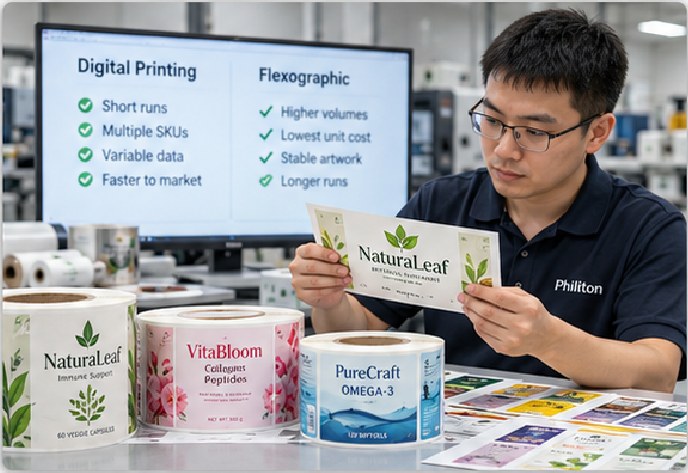
Digital printing is a core route for short runs, frequent artwork changes, multiple SKUs, prototypes, seasonal packs, variable information, and launch quantities. Most standard digital label projects can enter at relatively flexible quantities; Philiton commonly uses around 500 pieces per SKU or design as an entry reference for standard programs, subject to size, material, die cutting, finishing, and SKU structure. Digital production reduces traditional plate setup and allows file-driven version changes, which can be valuable when ten product variants share a technical platform but carry different graphics.
The main commercial advantage is not simply “small quantity.” It is lower setup exposure while the brand is still learning which products will reorder. A 12-SKU launch can avoid committing every version to the economics of a long, stable press run. Variable QR codes, serials, batch content, and frequent artwork updates can also fit digital workflows well when data rules and verification are defined.
Limits still matter. Special white ink, strict spot-color requirements, unusual films, heavy specialty layers, tooling, inspection, and finishing may change the best route. As single-SKU volume becomes stable, Philiton reviews whether flexographic production can lower unit cost and improve continuous roll efficiency. The review also considers whether a process switch would change approved color, white opacity, surface gloss, fine detail, or finishing alignment, because savings are only useful when the resulting label remains acceptable in use.
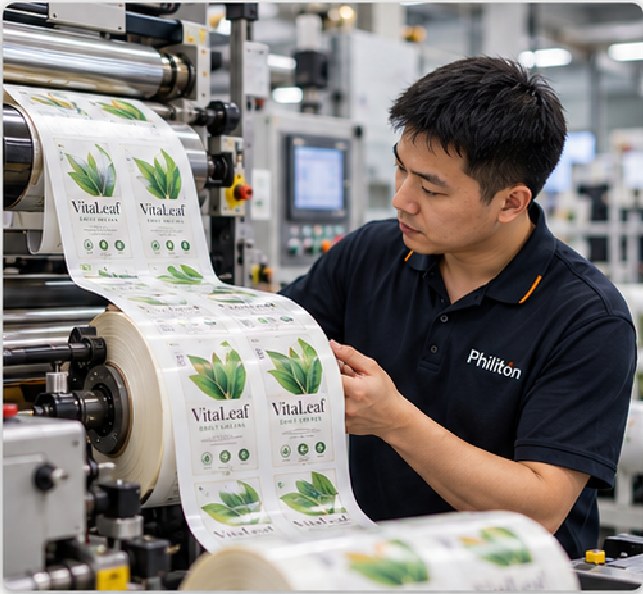
Flexographic printing becomes attractive when artwork is stable, repeat frequency is predictable, and quantity per SKU is large enough to spread plate, setup, registration, and press preparation across more labels. Philiton’s operating guidance starts evaluating flexographic economics as stable SKU volumes move into the several-thousand range and above; 5,000-50,000+ pieces per SKU often deserve comparison, while 50,000-500,000+ recurring programs can benefit from a higher-volume production route when materials, colors, finishing, and roll specifications support it.
No single crossover quantity applies to every label. A simple four-color roll label behaves differently from a multi-pass job with foil, embossing, opaque white, special adhesive, or frequent design revisions. A portfolio also does not need one universal answer. Hero SKUs can move toward flexographic production while long-tail versions remain digital.
Philiton reviews the change as a controlled manufacturing decision. Approved artwork, material performance target, die dimensions, winding rules, and inspection requirements stay tied to the product specification. If a process change can alter color or appearance, sampling or comparison against the approved reference becomes part of release. The objective is lower total manufacturing cost without creating a new visual or operational problem. For recurring programs, Philiton can compare not only unit price but also plate or tooling cost, changeover frequency, material utilization, SKU inventory exposure, expected reorder interval, and the cost of keeping slower variants on a more flexible route.
Growing brands often reach a stage where total annual label volume looks large, but the distribution is uneven. One SKU may sell 100,000 units while six variants remain below 10,000. Pricing the entire portfolio as if every SKU were identical hides setup, version, and inventory costs. Philiton can separate the portfolio by volume behavior while keeping common specifications synchronized.
A hybrid portfolio can use digital printing for development, long-tail items, regional packs, seasonal versions, and rapid artwork changes. Stable core products can use flexographic production when economics support the move. Shared material, adhesive, die size, liner, core, roll direction, and packing rules can simplify procurement even when print routes differ.
For planning, Philiton asks for more than total annual quantity. Quantity per SKU, number of artworks, reorder frequency, expected 6- or 12-month demand, color sensitivity, finishing, and production-line requirements help determine the route. The result is a manufacturing plan that can change with sales data instead of locking a brand into either “short run forever” or “large MOQ from day one.” Procurement gains a clearer view of which SKUs deserve scale economics, which ones still need flexibility, and which shared technical standards should remain unchanged across both production routes.
Philiton prices and controls multi-SKU work around both total quantity and quantity per artwork. Shared specifications reduce setup and handling complexity, but every version remains separately approved, counted, inspected, packed, and identified.
| SKU Situation | What Can Be Shared | What Stays Separate | Production Effect | Control Needed |
| 10 SKUs, same size/material/finish | Face stock, adhesive, die size, liner, core, winding, packing standard | Artwork, quantity, SKU ID, color content | Good fit for grouped digital planning | Artwork matrix, version naming, roll/carton identification |
| Same design, different language | Most construction and finishing variables | Regulatory copy, barcode/QR, language file | Efficient when revisions are controlled | Final text approval, proofing, version lock |
| Same product, different colorways | Material, die, roll format may be shared | Color targets and artwork files | May add color-control work | Color references, first article, SKU segregation |
| Different materials or adhesives | Limited setup sharing | Material, adhesive, press route, QC criteria | Often behaves like separate projects | Separate specification and approval path |
| Hero SKU plus long-tail SKUs | Brand standards, size, packaging rules | Print route and quantity per SKU | Digital + flexo mix may improve economics | Common spec fields with route-specific QC |
Special effects should strengthen shelf presence without creating avoidable setup, tooling, durability, material, or repeat-order problems as quantities and SKU counts increase across launches, seasonal versions, and recurring core products.

Hot or cold foil can create metallic accents, borders, typography, and premium details. Foil choice, coverage, minimum line width, substrate smoothness, tooling, registration, and later abrasion exposure all matter. Philiton reviews foil as part of the full construction rather than an isolated decoration. For growing ranges, keeping foil areas consistent across related SKUs can reduce unnecessary variation while preserving a recognizable brand system. Sample approval is recommended when small text, textured stocks, tight registration, or unusual foil colors are involved.

Embossing or debossing adds tactile depth but also adds tooling and registration considerations. Fine detail, paper or film stiffness, label size, adhesive layer, container curvature, and nearby print or foil elements affect the result. Philiton can evaluate whether a design has enough relief area to remain visible after application. When a brand adds more SKUs, reusing a common emboss structure may be more efficient than creating separate dies for every artwork. Exact reuse depends on tooling condition and whether design geometry stays unchanged.

Lamination and protective varnish can improve rub resistance, moisture resistance, scuff protection, appearance, and handling performance. Gloss, matte, soft-touch, clear protective films, and coating systems have different visual and functional effects. Selection should consider oils, condensation, filling-line abrasion, shipping friction, and whether the label must be written or overprinted later. Philiton evaluates finish together with face stock and ink adhesion; “laminated” does not automatically guarantee suitability for every chemical or outdoor condition.

Clear labels often need controlled white ink under brand colors, text, or graphics to prevent transparency from weakening contrast. White coverage also affects color appearance on clear or colored containers. Philiton can plan opaque areas, reverse-print structures where appropriate, clear windows, and no-label-look effects according to material and print route. As volumes grow, the approved white layer and color target should remain part of the artwork specification so later process changes do not quietly alter the intended appearance.
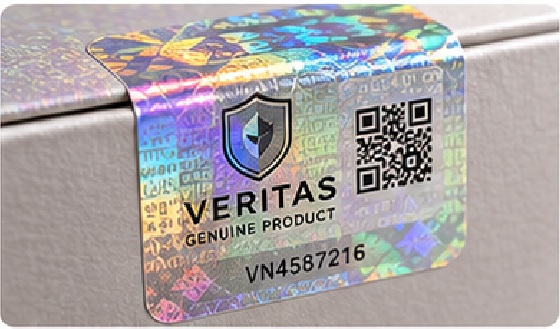
Holographic face stocks, security foils, VOID structures, destructible materials, tamper seals, scratch-off layers, and concealed codes can add authentication or tamper evidence. Security features require more than a visual sample. Philiton needs the intended evidence behavior, product surface, data rules, waste-control expectations, and inspection method. Special security materials may carry higher supplier minimums than standard stocks, so early planning is useful before a limited launch suddenly grows into a much larger protected-label program.
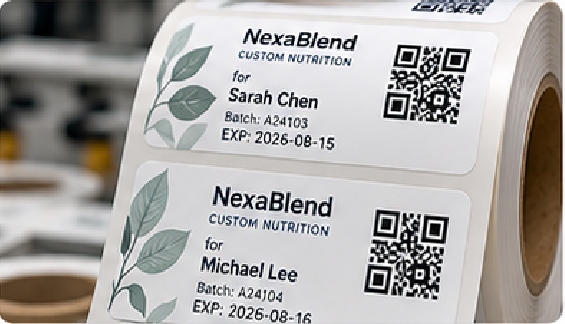
Serial numbers, unique QR codes, batch codes, Data Matrix, personalization, and other changing content can be combined with standard branding when the data workflow is defined. Philiton controls variable files, version or batch assignment, print output, verification, and reprint handling within the agreed scope. Growing programs should define who owns the data source, what makes a code unique, what verification is required, and how rejected labels are controlled. The variable layer should be designed as a production system, not added as a last-minute graphic field.
Philiton matches label construction to product, container, handling, storage, filling method, production route, and reorder pattern across categories where new SKUs and frequent replenishment are common and packaging conditions can vary widely.

Cosmetic bottles and jars may expose labels to water, oils, alcohol, repeated handling, and small diameters. Film, adhesive, white ink, foil, clear effects, and protective finishing can be reviewed against the actual pack. Multi-SKU color and artwork control becomes especially important as ranges expand and several similar bottles must remain visually consistent across repeated replenishment cycles.

Supplement programs often combine many bottle sizes, flavors, strengths, or market versions with dense text and barcode requirements. Philiton can control small text, artwork versions, variable codes, roll specifications, and protective finishes. Regulatory text is printed from brand-approved artwork; legal content remains the brand’s responsibility, while Philiton focuses on legibility, version control, barcode execution, and manufacturing consistency.

Dry, chilled, frozen, oily, glass, plastic, pouch, and carton applications require different label constructions. Philiton reviews application temperature, condensation, moisture, oil, container surface, direct or indirect food-contact context, and destination-market documentation needs before recommending material and adhesive options, especially when the same product line moves into chilled, frozen, or export channels.
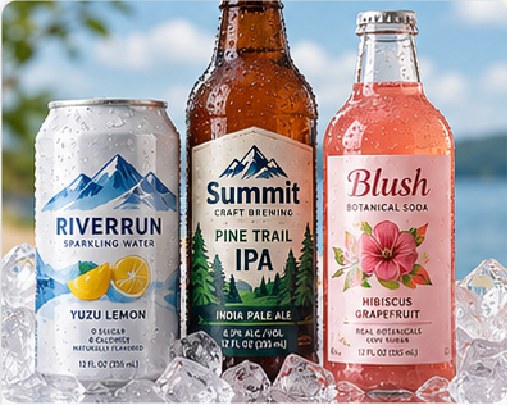
Beverage labels may need condensation resistance, wet-bottle performance, clear films, metallic effects, premium papers, or high-speed roll application. Bottle curvature, chill conditions, adhesive, label stiffness, roll direction, and applicator specifications should be considered before larger runs. Seasonal and flavor SKUs also benefit from digital version flexibility, allowing artwork updates without forcing every low-volume variant into the same high-volume production route.

Candle, diffuser, and home-fragrance brands often use textured papers, clear films, foil, embossing, matte finishes, and small-batch scent variations. Philiton can align material and finish with container type while controlling color and artwork across multiple scents. Heat exposure and oil contact should be evaluated where relevant, and finishing choices should be checked on the actual jar, vessel, or bottle before larger reorders.
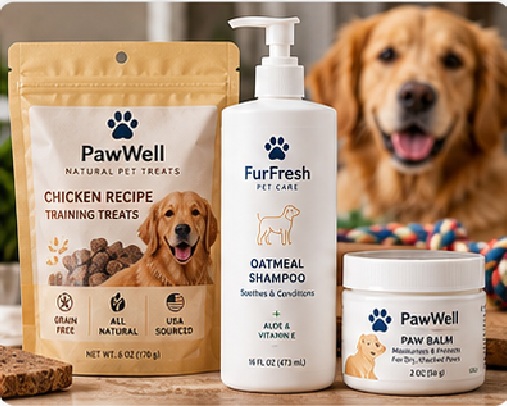
Pet products and specialty consumer goods can include pouches, bottles, jars, tubs, boxes, durable equipment labels, or serialized identification. Philiton can combine decorative branding with moisture, abrasion, barcode, tamper, or variable-data requirements while keeping SKU, pack, and reorder controls clear as product lines broaden across more formats, fulfillment routes, or retailer-specific versions.
Philiton begins with the information needed to build a label rather than guessing from artwork alone. The core input normally includes label size and shape, quantity, number of SKUs, application surface, material preference if known, adhesive or service conditions, printing colors, finish, roll or sheet format, roll direction and core where applicable, packing method, delivery destination, and artwork files. Existing samples or containers are useful when a brand is replacing an incumbent supplier or solving an application problem.
The intake stage is where hidden production risks are surfaced. A transparent BOPP label on a clear bottle may need white ink; a small HDPE container may need a different adhesive or softer construction; an automatic applicator may require a specific winding direction, gap, core, and maximum roll diameter. Variable QR codes or RFID add data and verification questions.
Growing brands benefit from giving Philiton quantity per SKU and expected reorder pattern, not only a total annual estimate. An order of 20,000 labels can mean one stable artwork or twenty versions of 1,000 each. Those two structures affect print method, setup, QC, and packing differently. Better inputs create a more useful quotation and reduce late-stage redesign. Philiton can also use the same intake to identify questions that belong in sampling rather than quotation, such as adhesive validation, applicator fit, code readability, foil detail, or tamper behavior. Separating commercial assumptions from technical unknowns keeps the first quote realistic instead of hiding unresolved risks inside a unit price.
Samples can confirm size, material, adhesive behavior, print appearance, finishing, die cut, roll configuration, and application performance before bulk production. The appropriate sample route depends on what needs to be proven. A digital printed sample can be useful for artwork, color direction, size, and material appearance. A material sample can isolate adhesive or surface questions. A production or functional sample may be required when final tooling, special finishing, tamper behavior, RFID performance, or automatic application is important.
Sample method can differ from final mass production when the bulk route carries high setup cost, dedicated plates, special tooling, or unusual materials. Any known difference should be identified during review rather than hidden behind a “sample approved” label. For straightforward digital samples using available materials, rush turnaround can be evaluated as fast as 24-48 hours after artwork and specifications are confirmed; normal timing remains dependent on material, finish, tooling, and production loading.
Approval should lock the fields that matter: artwork version, size, face stock, adhesive, color or print target, finishing, die, and roll configuration where relevant. The approved sample or signed specification then becomes a production reference, reducing ambiguity when a launch order moves into repeat production. If later scale-up requires another print method, the original approved construction provides a baseline for comparison so color, opacity, finish, die cut, and application behavior can be reviewed deliberately rather than assumed to remain identical.
Visual approval is not enough when labels must survive refrigeration, freezers, oil, chemicals, condensation, small-diameter wrapping, squeeze movement, rough plastics, or automatic application. Philiton can evaluate actual containers or representative substrate samples for adhesion, wrap behavior, edge lift, print rub, finish durability, barcode or QR readability, tamper response, and line-related specifications where applicable.
Testing should reproduce the relevant condition as closely as possible. Applying a label to a cold, wet bottle is different from applying it dry and cooling it later. An adhesive can have one minimum application temperature and a lower service temperature after bonding. An oil-resistant film still needs an adhesive and protective print structure suited to the container and exposure.
For automatic application, sampling can also check unwind direction, release liner behavior, gap, pitch, core, sensor compatibility, and label stiffness. Resolving these issues before 20,000 or 100,000 labels are produced is much cheaper than discovering them on a filling line. Philiton uses sample and verification results to support specification release rather than treating sampling as a cosmetic preview. When a brand has several related SKUs, one carefully selected worst-case pack can sometimes expose the highest curvature, lowest surface energy, coldest application condition, or most demanding artwork feature before the broader family is released.
Request a Sample
Mass production starts from an approved manufacturing specification, not from the latest email attachment. Philiton’s engineering flow records artwork version, label dimensions, face stock, adhesive, printing route, color requirements, finishing, die cutting, liner, roll direction, core, gap or pitch, labels per roll, packing, and relevant inspection points. Material and tooling availability are also checked before active production starts.
This discipline becomes more important when one brand has many similar artworks. A small language change, barcode revision, ingredient update, or retailer-specific pack can be easy to miss when filenames are inconsistent. Philiton uses project and artwork controls to separate versions and link the released file to the order quantity and SKU identification.
Across Philiton’s Shenzhen and Dongguan manufacturing operations, the combined system includes more than 12,000 ㎡ of factory and operating space, 200+ employees, and 91 technical, skilled production, and quality personnel. Production lead time is confirmed per order because artwork readiness, sample approval, material availability, tooling, quantity, printing process, finishing, QC, packing, and approval delays all affect scheduling. Rush projects can be evaluated when materials and capacity allow, but the manufacturing specification is not bypassed to save time. A fast wrong run is still a wrong run. For large or time-sensitive launches, Philiton can also identify which approvals are truly on the critical path – material, artwork, tooling, color, variable data, or packing – so teams can shorten waiting time without removing the controls that prevent a costly production error.
A useful quotation starts with enough information to understand the label, the application, and how the program may grow. Send the files and operating details already available; Philiton can help fill technical gaps during review. For multi-SKU programs, include quantity per artwork rather than one combined total. If an existing label is being replaced, photos, a physical sample, container information, current roll specification, and the reason for changing suppliers can speed comparison. For new launches, expected reorder frequency and a 6- or 12-month volume estimate help Philiton compare short-run and scale-up production routes without forcing an early volume commitment. Mention any known risks such as freezer storage, oil exposure, small bottle diameter, automatic application, strict color references, foil or embossing, variable QR codes, security structures, or destination-market documentation. Philiton will use the information to organize material, process, sampling, QC, packing, and quotation questions before production planning begins, so the first commercial discussion is based on a manufacturable specification rather than artwork alone.
For all inquiries, please feel free to reach out at:
Our team will answer your inquiries within 12 hours.
Your information will be kept strictly confidential.
We will contact you within 24 Hours, please pay attention to the email with the suffix“@philiton.com”.
For all inquiries, please feel free to reach out at:
We will contact you within 24 Hours, please pay attention to the email with the suffix“@philiton.com”.
For all inquiries, please feel free to reach out at:
We will contact you within 24 Hours, please pay attention to the email with the suffix“@philiton.com”.