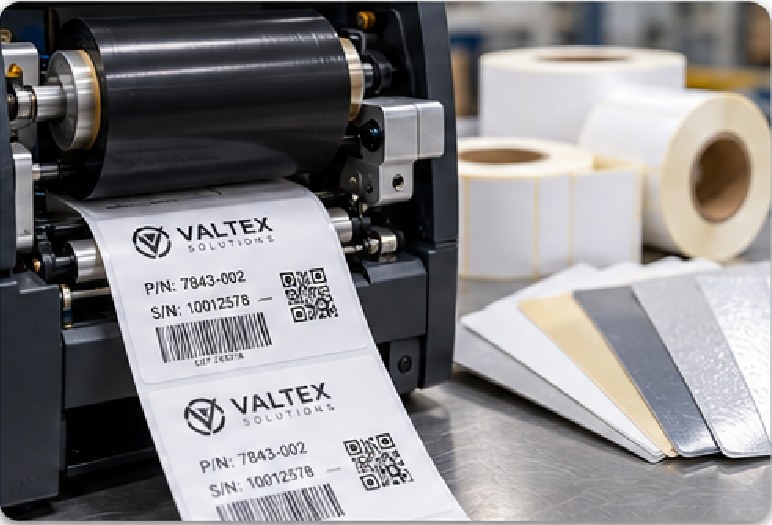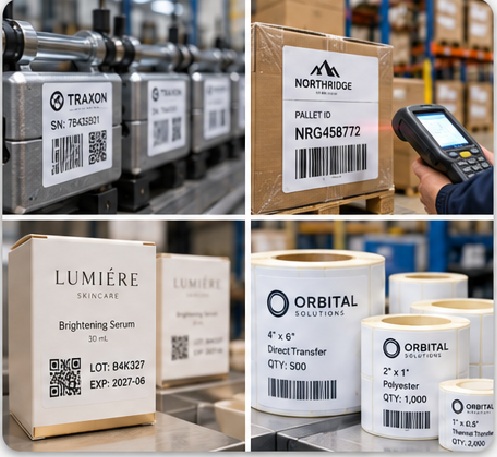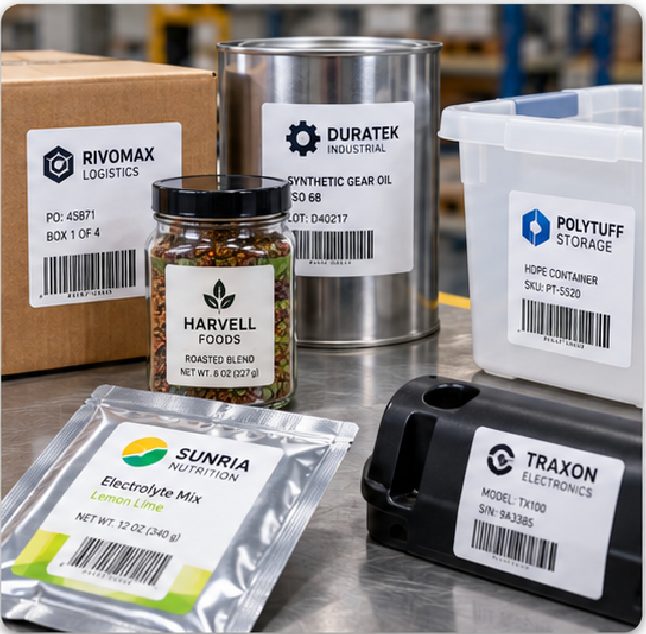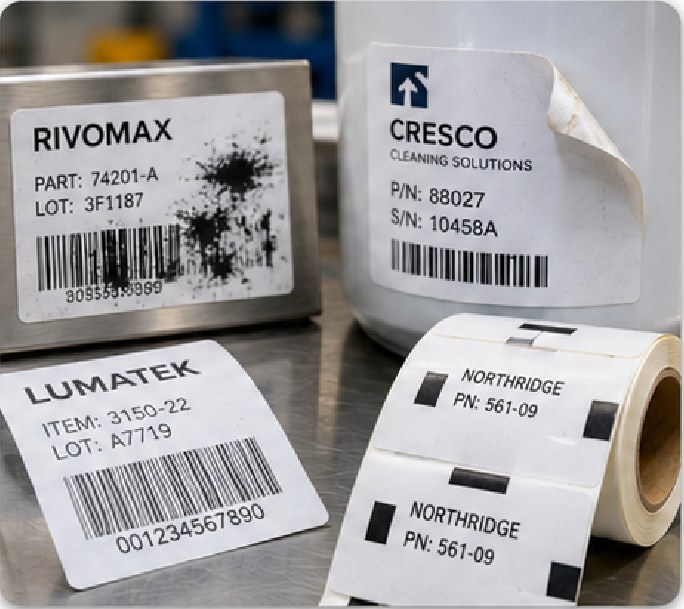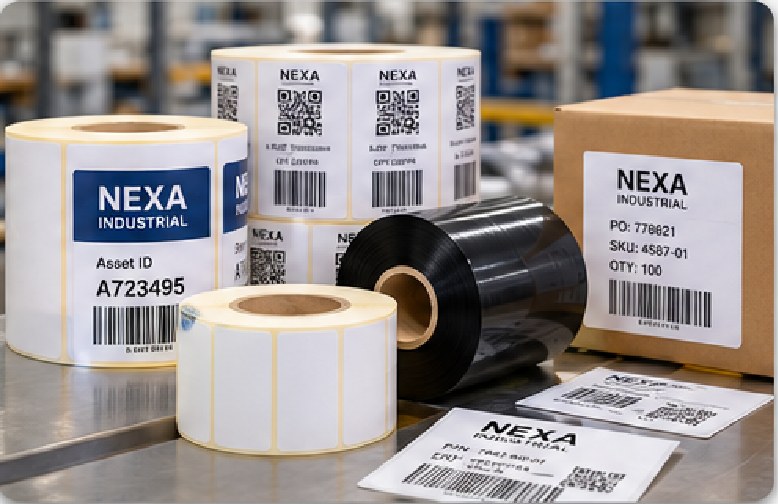
Thermal transfer printing transfers ink from a ribbon onto the label surface through controlled heat and pressure. The method is widely used for barcodes, serial numbers, lot codes, asset IDs, warehouse locations, electronics identification and industrial traceability because variable information can be printed close to the point of use.
Philiton manufactures the blank or preprinted label stock that enters that workflow. Static branding, warning text, color areas, borders, logos or fixed instructions can be printed during manufacturing, while a reserved variable-print zone remains available for later thermal transfer printing. The finished construction can use thermal transfer paper, coated paper, BOPP, PET, synthetic paper or durable film, depending on the required durability and application surface.
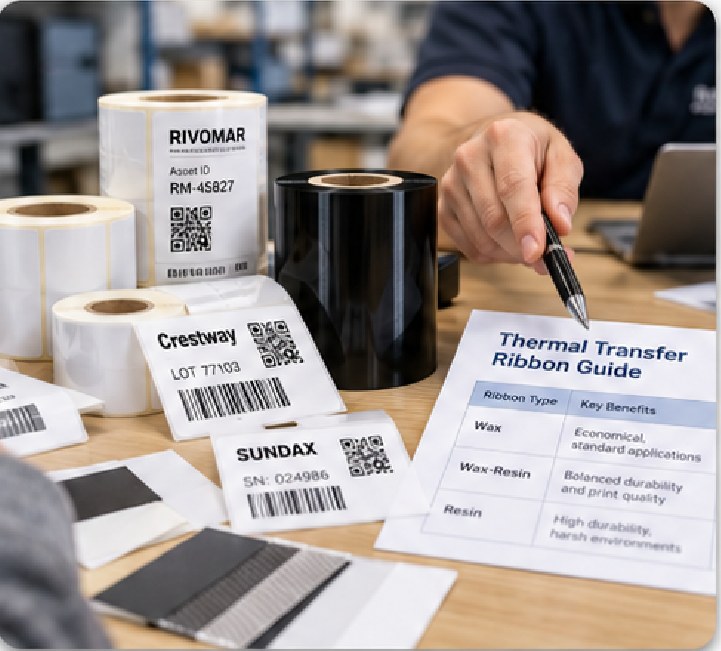
A correct construction is not selected by appearance alone. Ribbon family, facestock coating, adhesive, liner, printer configuration, application surface, temperature, abrasion, chemical exposure and roll format all affect performance. Wax ribbons are often paired with paper for economical indoor identification. Wax-resin extends resistance on coated papers and synthetics. Resin is commonly evaluated for PET and more demanding industrial conditions.
Philiton does not treat thermal transfer printing as garment heat transfer or as a printer-sales category. The manufacturing focus is pressure-sensitive labels and tags engineered for downstream thermal transfer printing, barcode readability and repeat production.
Different operating environments require different constructions, roll formats and durability levels. Philiton organizes development around the real application, printer setup, identification task and reorder pattern.
| Facestock | Typical Ribbon Family | Typical Uses | Durability Priority | Philiton Engineering Note |
|---|---|---|---|---|
| Thermal Transfer Paper | Wax | Warehouse, carton, inventory, retail operations | Economy and clean barcode output | Best for controlled indoor use where long-term moisture and abrasion resistance are not the primary requirement. |
| Coated Paper | Wax / Wax-Resin | Logistics, product ID, batch and tracking labels | Better rub resistance than basic paper | Coating and ribbon should be tested together when dense barcodes, fine text or frequent handling are expected. |
| BOPP / Synthetic Film | Wax-Resin / Resin | Packaging, warehouse, moisture-prone applications | Moisture and handling resistance | Surface coating and ribbon chemistry must support image anchorage; adhesive still depends on the actual substrate. |
| PET / Durable Film | Resin | Electronics, asset, industrial and chemical identification | High abrasion and environmental resistance | Often selected for demanding programs, but chemical, heat and service-life claims require project-level validation. |
| Specialty Synthetic Stock | Wax-Resin / Resin | Curved, flexible or application-specific labels | Balanced printability and durability | Construction is chosen after reviewing flex, surface energy, environmental exposure and printer settings. |
Material and ribbon should be selected as one system. The matrix below shows common starting points; final construction is confirmed against the surface, environment, printer and required durability.
Both technologies support variable information, but the right choice depends on required image life, operating environment, consumables, storage conditions and label construction.
| Decision Factor | Thermal Transfer | Direct Thermal |
|---|---|---|
| Ribbon | Required | Not required |
| Printable Surface | Paper, BOPP, PET, synthetic and durable films can be evaluated | Heat-sensitive coated material required |
| Image Durability | Can be increased through facestock and ribbon matching | More sensitive to heat, light and long storage conditions |
| Abrasion / Chemical Resistance | Can be engineered upward with wax-resin or resin systems | Generally more limited for demanding long-life identification |
| Typical Uses | Asset, industrial, electronics, warehouse, chemical, traceability | Shipping, receipts, short-life logistics and temporary identification |
| Operating Cost | Includes ribbon consumption | No ribbon consumption |
| Selection Priority | Long-term readability and broader material choice | Simpler operation and short-life labeling |
A barcode can print perfectly and still fail in service if the adhesive is wrong. Philiton reviews the actual substrate before locking the construction: corrugated board, coated carton, glass, metal, PET, PP, HDPE, painted housing, flexible packaging or another surface. Low-surface-energy plastics, powder-coated parts, rough containers and curved parts can require a different adhesive route from smooth paperboard or glass.
Application temperature also matters. A label applied to a cold or wet surface can fail even if the adhesive is rated for lower service temperatures after full bonding. Condensation, oil, dust, release agents and surface contamination can prevent proper wet-out. For small-diameter containers, facestock stiffness and label shape may also create edge-lift forces.
Philiton separates adhesive selection from ribbon selection. Ribbon is responsible for transferring and anchoring the variable image to the facestock. Adhesive is responsible for bonding the finished label to the end-use surface. When both conditions are demanding, the structure may combine a durable PET or synthetic facestock, resin-compatible coating, protective finishing where needed, and an adhesive selected for the substrate and environment.
For higher-risk applications, samples should be applied to the actual or representative surface and checked after the relevant temperature, moisture, oil, alcohol, cleaning or abrasion exposure. Specific durability claims are confirmed from material data and project testing rather than assumed from a generic label name.
Reliable feeding depends on more than label size. Philiton converts printer and applicator requirements into a controlled roll specification before mass production.
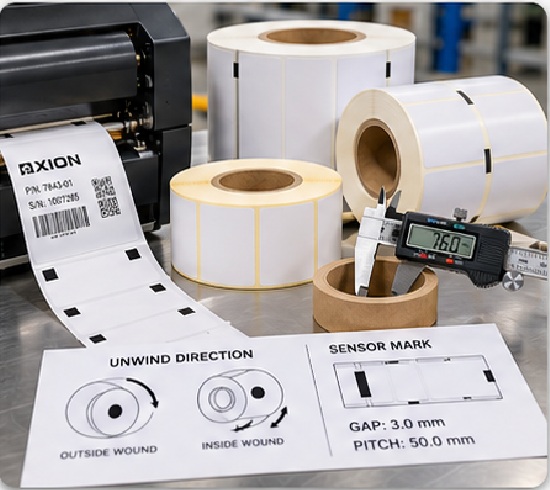
Core size and maximum roll diameter are confirmed from the printer, dispenser or applicator specification. A larger finished roll can reduce changeovers, but only when the machine can physically accept the diameter and weight. Labels per roll are calculated together with label pitch, liner thickness and core. Philiton records the approved core, roll quantity and packing configuration so repeat orders can reproduce the same operating format. Roll weight and handling limits can also be considered where frequent operator changes are expected.
Unwind direction defines which edge leads from the roll and how the artwork is oriented as labels enter the printhead or applicator. Inside-wound and outside-wound formats are not interchangeable on every machine. Philiton confirms the required orientation before die cutting and rewinding. A machine diagram, previous roll sample or clear photo can be used when the specification is not known internally. Artwork orientation is then tied to the approved unwind reference rather than assumed from the visual design.
Gap is the space between adjacent die-cut labels on the liner. Pitch is the repeat distance from one label position to the next. Both affect indexing, sensor detection and the available print area. Philiton reviews label size, die-cut geometry, liner and printer requirements before setting the repeat. Tight or unusual layouts should be validated instead of relying on a standard gap used for unrelated jobs. The repeat also influences labels per roll and available variable-print space.
Sensor behavior can depend on liner opacity, transmissivity, black marks, notches and the contrast between the label and backing. Philiton can add black marks or other registration features when specified by the equipment. Size and position are controlled from the machine requirement. Liner width and edge margin are also set so the web tracks consistently through the printer and does not interfere with guides. Sensor requirements should be supplied before tooling is released.
Rolls are the most common format for continuous thermal transfer printing, while fanfold can be useful for some desktop, shipping or high-consumption workflows. Philiton evaluates the required delivery format together with stack handling, perforation, fold repeat, carton packing and the final printing route. The choice should follow equipment and operating preferences rather than copying a format from another label program. Perforation and fold handling can be added where the converting route allows.
When specifications are incomplete, Philiton can work from the printer or applicator model, current label sample, roll photographs, core measurement, maximum roll diameter, web width and sensor details. The objective is to convert operating information into production fields that can be inspected: label size, winding, core, roll OD, gap, pitch, liner width, perforation or black mark, and quantity per roll. Unknown fields are resolved before mass production, quotation release and final tooling confirmation.
Most failures are traceable to a mismatch between material, ribbon, printer settings, adhesive, roll construction or application conditions. Philiton reviews the failure mode before changing components.
Quality control covers the full construction, not only visual printing. Philiton links material, converting, barcode performance and final roll condition to the approved specification.
Philiton uses incoming, in-process, final and outgoing inspection stages across label production. Incoming checks verify material identity, appearance and project-relevant specifications before conversion. First-piece and in-process checks focus on dimensions, print registration, color, die cutting, waste stripping, roll configuration and defects that can multiply during a long run.
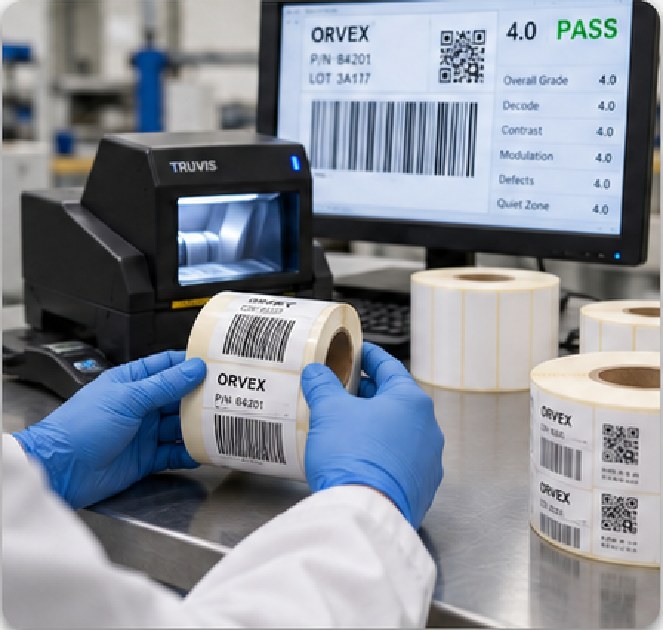
For thermal transfer labels, printable-surface consistency and downstream code performance are especially important. Philiton’s quality equipment includes barcode and QR verification systems, peel adhesion and tack test systems, rub and abrasion testers, color measurement equipment, environmental chambers and automatic label inspection rewinders. The exact test plan depends on the product risk and agreed acceptance criteria rather than applying every laboratory test to every order.
Barcode quality is evaluated with the code structure in mind: contrast, edge definition, quiet zones, size and print condition. Variable-data jobs can add data verification, duplicate controls and restart procedures. Roll inspection also checks missing labels, splices where specified, winding quality, roll direction and finished quantity.
A thermal transfer program is released against approved artwork, sample or specification. If a quality complaint occurs, Philiton reviews the affected SKU and batch together with photographs, application conditions, retained records and inspection data to identify whether the root cause relates to printing, converting, material, adhesive, application or transport. Corrective action is then defined around the verified cause.
Commercial planning depends on construction, quantity, SKU count and roll requirements. The figures below are standard working ranges; special materials, complex testing and unusual tooling are confirmed separately.
| Item | Philiton Working Range / Approach | What Changes the Result |
|---|---|---|
| Thermal Transfer Label MOQ | Blank or preprinted projects commonly evaluated from about 500-1,000 pcs | Material availability, size, tooling, SKU count, adhesive, finishing and roll configuration |
| Blank Material / Swatch | About 1-2 working days when stock is available | Special materials, imported stock, custom adhesive |
| Digital Sample | About 1-3 working days, commonly 10-50 pcs/design | Artwork readiness, material and color requirements |
| Printed / Finished Sample | About 3-5 working days, commonly 10-100 pcs | Die cutting, coating, printing complexity and finishing |
| Standard Production | Commonly about 5-10 working days after approval and material readiness | Quantity, SKUs, print colors, converting steps and inspection plan |
| Repeat Order | Commonly about 3-7 working days when specification is unchanged | Material stock, machine load and any artwork or construction changes |
| Larger Production Run | Commonly about 7-15 working days; complex multi-SKU orders may require longer or split delivery | Total print area, number of rolls, SKU changes, finishing, inspection and packing |
| Delivery Format | Roll, fanfold, sheet or individual formats as applicable | Printer, applicator, handling and warehouse receiving rules |
| Shipping | Courier, air or sea can be arranged | Destination, carton volume, urgency, Incoterm and customs requirements |
Philiton can quote from a complete production drawing or help turn an incomplete requirement into a workable label specification. For the fastest review, send the information already available and leave uncertain technical fields for engineering confirmation. A printer model, current roll sample, substrate photo or existing specification can often replace several unknown measurements. After reviewing the application, Philiton can recommend a material and adhesive route, confirm whether wax, wax-resin or resin should be evaluated, define roll-format requirements, prepare the appropriate sample route and quote production based on the approved construction. For ongoing programs, the approved artwork, material, die line, winding, core, roll quantity and packing instructions can become the reference for future reorders. If an existing label already runs well, sending one roll or a clear specification often shortens development because Philiton can compare the new requirement against a working format. If the current label is failing, include photos, affected surface, operating temperature and printer details so the review starts from the failure condition rather than from appearance alone.
Please include where available:
Our team will answer your inquiries within 12 hours.
Your information will be kept strictly confidential.
We will contact you within 24 Hours, please pay attention to the email with the suffix“@philiton.com”.
For all inquiries, please feel free to reach out at:
We will contact you within 24 Hours, please pay attention to the email with the suffix“@philiton.com”.
For all inquiries, please feel free to reach out at:
We will contact you within 24 Hours, please pay attention to the email with the suffix“@philiton.com”.