Your Trusted Labels & Stickers Manufacturer from China!

Labels for New Product Launch

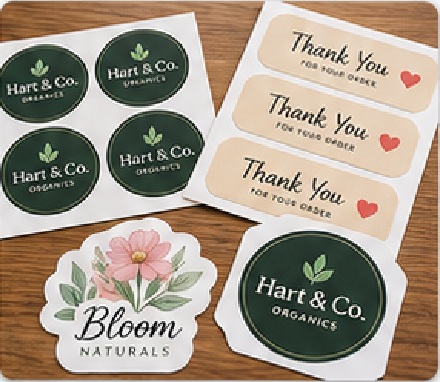
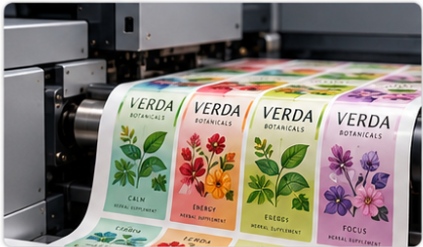
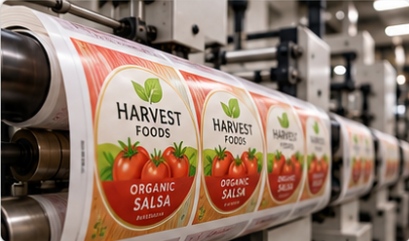
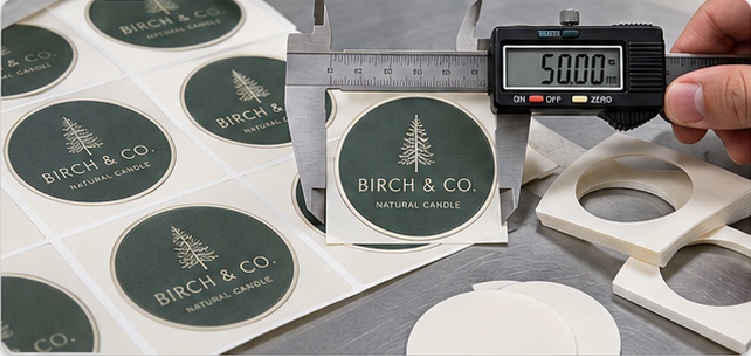
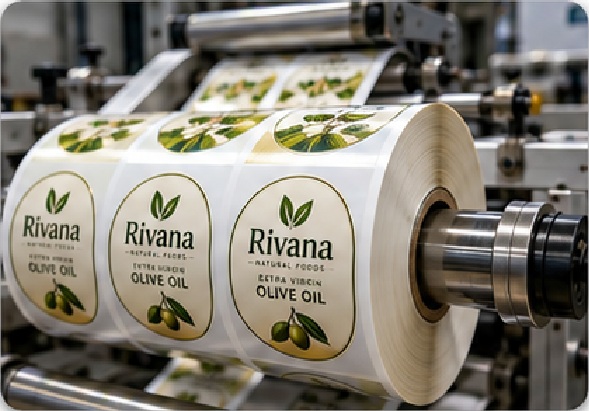
Launch labels built for first runs, multi-SKU releases, brand validation, and a controlled path into repeat production. Philiton supports launch programs from artwork review and material selection through sampling, printing, finishing, inspection, packing, and scale-up.

  • Founded in 2016 with manufacturing in Shenzhen and Dongguan
  • Around 500 pcs for many standard label and sticker projects
  • Digital, flexographic, specialty finishing, inspection, and testing under one production system
Labels for New Product Launch

Start a Launch Run Without Locking Too Much Inventory

Early production should prove the label on the real product, protect launch timing, and preserve room for artwork or SKU changes before higher-volume replenishment begins.

Start at a Manageable Quantity

Many standard Philiton label and sticker projects can begin at around 500 pieces per design or SKU, subject to material, tooling, finishing, and supply conditions. A first run should cover launch needs plus a sensible operating buffer, not an oversized forecast built on untested demand. Lower initial exposure makes artwork changes, pack-size changes, or SKU adjustments easier to absorb before repeat orders become larger.

Validate Before Repeating

A launch label should be checked on the intended bottle, jar, pouch, box, tube, or other package before repeat volume is committed. Philiton can review label fit, material behavior, adhesive suitability, color, white ink, finishing, barcode or QR readability, and roll configuration. Validation is especially important when the product meets moisture, oil, alcohol, refrigeration, tight curvature, low-surface-energy plastic, or automatic labeling equipment.

Keep SKU Structure Organized

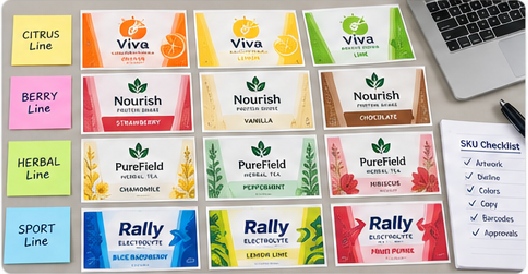
Multiple flavors, scents, colors, languages, or pack sizes can share a common production platform when dimensions, material, adhesive, roll format, or finishing are standardized. Philiton separates artwork versions and production quantities by SKU while looking for specifications that can remain common. Standardization lowers avoidable setup work and makes later replenishment easier to reproduce without losing control of the individual variants.

Build for the Next Order

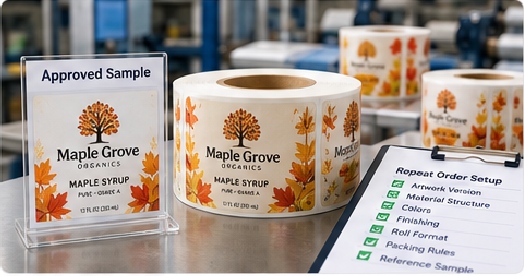
A launch run should not create a specification that becomes expensive or difficult to reproduce when demand grows. Philiton can begin with digital production for flexible volumes and multiple artworks, then review flexographic or other routes as repeat quantities rise. Approved artwork, material structure, finishing targets, roll configuration, packaging rules, and reference samples form the basis for controlled repeat production instead of restarting development.

Launch Programs Need Input From More Than One Team

Philiton structures label development around the people who approve appearance, engineering, cost, production fit, regulatory text, and release timing before a new SKU enters the market.

Brand and Product Teams

Brand and product teams need a label that looks ready for market without creating excessive opening inventory. Philiton helps convert a launch concept into material, finish, size, print, and quantity decisions that can be quoted and sampled. Early discussion should include the product category, package type, launch date, SKU count, target appearance, sales channel, and expected first run so visual choices stay connected to manufacturing reality.

Packaging Engineering

Packaging engineering focuses on fit, surface, curvature, application method, roll format, and environmental exposure. A label that looks correct on screen can still lift, wrinkle, bridge a curve, or feed poorly on equipment. Philiton reviews container material, label dimensions, adhesive needs, liner, gap, pitch, roll direction, core requirement, maximum roll diameter, and sensor marks when relevant, so production specifications match the actual packaging line.

Procurement and Sourcing

Sourcing teams need a commercial path that works at launch volume and remains usable as demand grows. Philiton separates one-time items, project-dependent material minimums, per-SKU quantities, finishing steps, tooling, and production routes instead of treating every label as the same cost structure. Clear specifications also make later price reviews more meaningful because changes in quantity, material, artwork count, finishing, or packing can be evaluated against the approved launch version.

Marketing and Design

Marketing and design teams care about color, transparency, texture, foil, embossing, tactile effects, and how the pack presents at shelf or in e-commerce photography. Philiton connects those goals to print and material limits. Clear film may need controlled white ink, kraft changes color appearance, metallic stocks affect contrast, and foil zones need separate artwork layers. Physical samples help prevent a strong screen concept from becoming a weak printed result.

Operations and Co-Packers

Operations teams need labels delivered in a format that can run without extra sorting or setup surprises. Hand-applied launches may accept sheets or individual pieces, while automatic lines need roll specifications controlled before production. Philiton can confirm winding direction, inside or outside wound construction, core, roll diameter, gap, pitch, liner width, perforation, black mark, labels per roll, and SKU identification according to the filling or packing operation.

Quality and Regulatory Teams

Quality and regulatory teams need approved content reproduced correctly and evidence linked to the actual material or project. Philiton can support artwork control, inspection, testing, material documentation, and third-party testing coordination where required. Legal claims, warnings, ingredient statements, certification marks, destination-market obligations, and final market authorization remain subject to the responsible brand or legal party, while Philiton controls manufacturing against the approved specification.

Six Launch Risks to Resolve Before Labels Reach Production

Most launch failures come from decisions made too late: quantity, artwork, material, SKU control, schedule, or repeatability. Philiton brings those decisions forward before bulk printing.
First-Run Inventory Risk

First-Run Inventory Risk

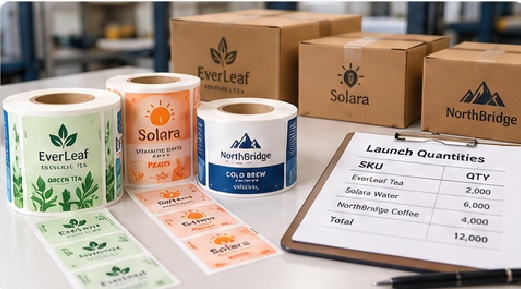
Ordering far beyond a first production need can turn a small artwork revision into a large write-off. Philiton supports flexible launch quantities for many standard constructions and helps separate total program volume from quantity per SKU. A 12,000-label launch may be one design at 12,000 pieces or six designs at 2,000 each; the production logic and setup work are not the same.
Artwork Revision Risk

Artwork Revision Risk

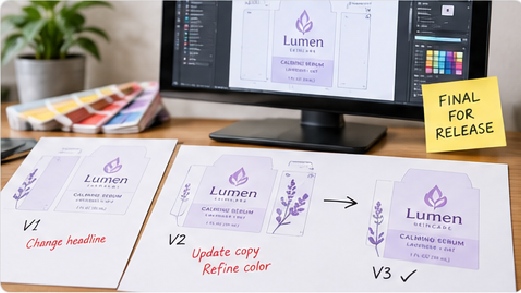
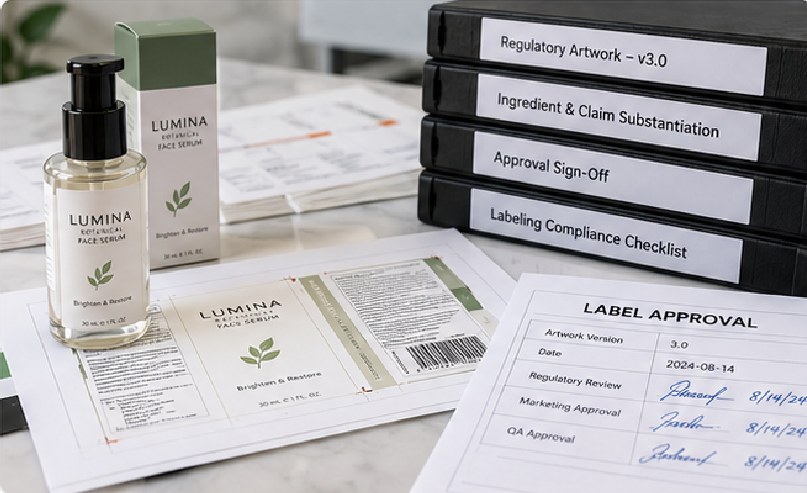
Launch artwork changes can come from final claims, retailer feedback, barcode assignments, language updates, pack-size changes, or design refinement. Philiton uses controlled artwork review and revision approval before release. The production file should lock label dimensions, dieline, bleed, safe zone, colors, white ink, finishing layers, variable data rules, and version identity so an obsolete file does not enter a later production step.
Material Mismatch Risk

Material Mismatch Risk

A beautiful label can fail after filling, refrigeration, shipping, handling, or exposure to oils and cleaners. Philiton selects material and adhesive families around the actual package and use conditions rather than appearance alone. Glass, PET, PP, PE, HDPE, coated paperboard, textured cartons, and flexible packaging create different surface and geometry conditions, so representative package testing can be more valuable than a generic material description.
Multi-SKU Control Risk

Multi-SKU Control Risk

New lines often launch several flavors, scents, strengths, colors, languages, or pack sizes together. Small artwork differences can create large warehouse or production errors if files, rolls, cartons, and quantities are not identified clearly. Philiton manages SKU-specific artwork and packing while standardizing shared specifications where possible. Roll labels can be separated by SKU, quantity, batch, and carton marking for easier receipt and line use.
Launch Schedule Risk

Launch Schedule Risk

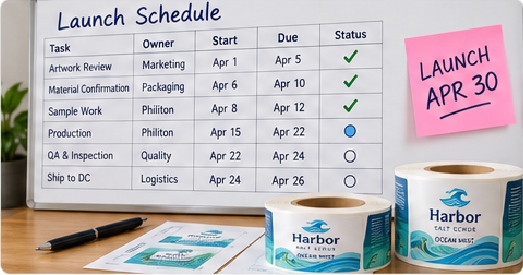
Labels sit between approved artwork and the final packing date, so late decisions compress every downstream step. Philiton schedules artwork review, material confirmation, sample work, approval, production, inspection, packing, and freight against the required launch date. Rush paths may be possible for straightforward digital work using available materials, but complex finishing, special substrates, tooling, or new compliance requirements need additional planning before a reliable release date is confirmed.
Scale-Up Reset Risk

Scale-Up Reset Risk

A launch specification built only for a tiny first run may become difficult to reproduce at higher volume. Philiton records approved artwork, material structure, colors, finishing, converting details, roll format, packing rules, and reference samples so repeat orders can begin from a controlled baseline. As quantities grow, the print route can be reviewed for digital, flexographic, or hybrid economics without changing the approved product outcome unnecessarily.

Choose a Production Route by Launch Stage

A launch label should match the maturity of the product. Philiton changes the validation depth, production route, and control points as a SKU moves from concept to repeat supply.

Launch StageTypical SituationPhiliton RouteConfirm Before Release
ConceptPackaging and artwork still evolvingMaterial swatches, artwork review, digital proof or samplePackage surface, size, visual direction, key claims
PrototypePhysical pack needs evaluationDigital sample or production-style sampleFit, color, opacity, finish, adhesive direction
First RunMarket launch with controlled inventoryDigital or suitable short-run productionApproved artwork, quantity per SKU, packing format
Multi-SKU LaunchSeveral flavors, scents, languages, or sizesShared material platform with SKU-specific artwork controlVersion matrix, per-SKU quantity, roll and carton ID
GrowthReorders become larger and more predictableDigital retained or flexographic route reviewedGolden sample, repeat tolerances, tooling, QC points
Repeat SupplyStable SKUs with regular replenishmentControlled repeat production and batch recordsCurrent revision, material status, forecast, delivery plan

Label Formats for New Products Across Consumer Packaging

Philiton supports launch labels in roll, sheet, and individual formats, with materials and finishes selected around the package, filling process, application method, and retail presentation.
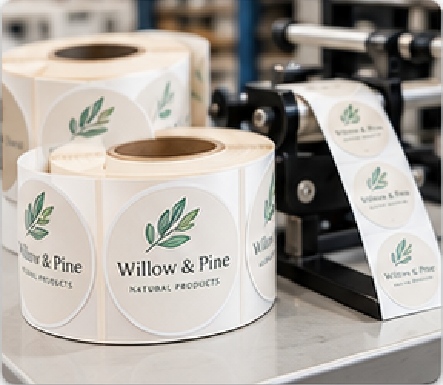
Pressure-Sensitive Roll Labels

Pressure-Sensitive Roll Labels

Roll labels fit hand dispensers, semi-automatic equipment, and automatic applicators when winding and converting details are controlled. Philiton can confirm roll direction, inside or outside wound construction, core requirement, maximum roll diameter, gap, pitch, liner width, perforation, black marks, and labels per roll. Roll supply is especially useful when the launch is filled or packed by a co-packer using defined machine settings.
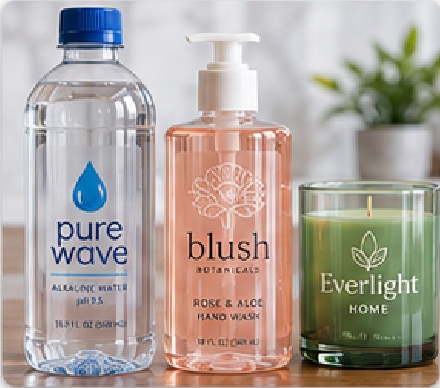
Bottle Labels

Bottle Labels

Bottle projects need more than an attractive front panel. Diameter, taper, surface material, filling temperature, condensation, oil exposure, and hand or machine application influence label construction. Philiton can produce paper or film bottle labels with clear, white, metallic, matte, gloss, foil, embossed, or variable-data features. Representative bottle samples are recommended when curvature, low-surface-energy plastic, or cold application can affect adhesion.
Jar Labels

Jar Labels

Jar labels can combine front, back, wrap, lid, seal, or tamper-evident elements depending on the product. Glass jars often provide a favorable bonding surface, but condensation, oily contents, hot filling, refrigeration, textured glass, and narrow diameters still affect performance. Philiton can coordinate the visual system across several label positions so the launch pack looks consistent while each component remains suitable for its own application area.
Clear Labels

Clear Labels

Clear BOPP or PET can create a no-label look on transparent or colored containers, but the artwork requires deliberate opacity planning. White ink is often needed beneath colors or text to prevent the package color from changing printed appearance. Philiton reviews white-ink layers, transparent windows, barcode contrast, varnish or laminate, and container color before sampling so transparency works as a controlled design feature rather than an accidental loss of readability.
Premium Paper Labels

Premium Paper Labels

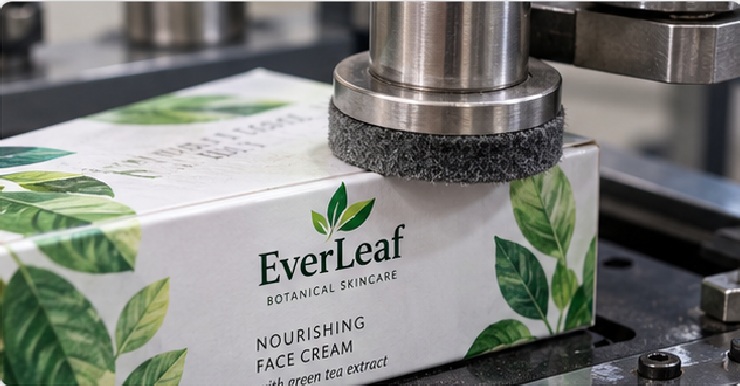
Coated, uncoated, kraft-style, and textured papers can give a launch a tactile or crafted presentation. Paper selection should also consider moisture, scuffing, filling environment, and the possibility of protective varnish or lamination. Philiton can combine paper with foil, embossing, debossing, spot effects, or controlled color printing. Premium paper is strongest when the package environment supports the material rather than forcing decoration to solve an engineering mismatch.
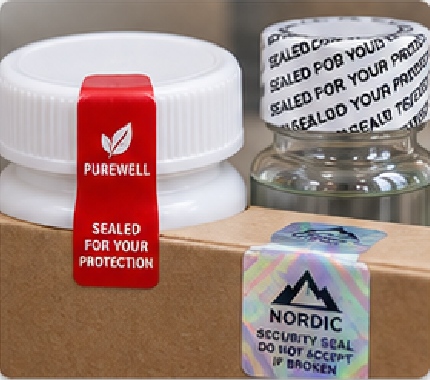
Tamper-Evident Seals

Tamper-Evident Seals

A new product may need visible opening evidence at a cap, lid, carton flap, warranty area, or protected access point. Philiton can evaluate VOID, destructible, security-seal, and other tamper-evident constructions according to the substrate and desired evidence after removal. The final behavior should be checked on the real surface because transfer, breakage, residue, and removal characteristics depend on the label construction and the package material.
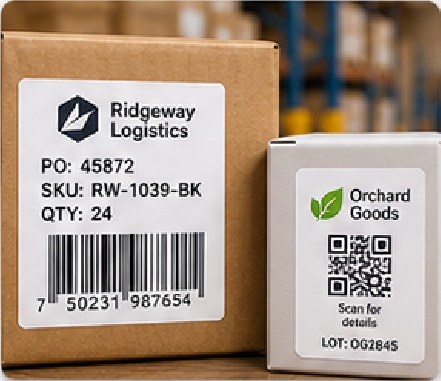
Barcode and QR Labels

Barcode and QR Labels

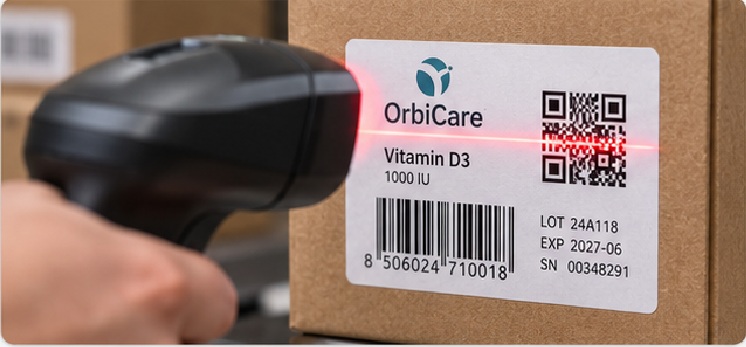
Retail barcodes, warehouse codes, QR links, lot data, coupons, and serialized identifiers can be integrated into the launch label or produced as separate labels. Philiton reviews code size, contrast, quiet zone, print process, curved-surface distortion, variable-data source, and verification needs. A code that scans once on a phone is not enough for a controlled retail or industrial program; verification criteria should match the intended scanning environment.

Sheet and Individual Labels

Sheet or individual-piece formats suit manual launch work, kits, promotional packs, prototypes, low-volume assembly, or products not running through a roll applicator. Philiton can die cut custom shapes and organize pieces by SKU or pack. When the same design later moves to roll application, the specification should be reviewed again because liner, gap, orientation, core, roll diameter, and dispensing behavior become part of the finished label requirement.

Select Materials From the Product Environment, Not Appearance Alone

Material choice starts with package surface, exposure, expected life, print effect, and application method. Philiton narrows the material family before a specific construction is approved.

Paper Labels for Dry, Tactile, and Premium Presentation

Paper remains a strong launch option when the package environment is relatively dry and the brand direction values texture, print character, or a crafted feel. Coated paper can deliver cleaner graphics and more predictable color; uncoated or textured paper changes ink holdout and can produce a softer, more tactile result. Kraft-style materials add natural visual character but also shift printed color because the base is not white. A brand color approved on white film should never be assumed to look identical on kraft or textured stock. Philiton reviews the package, handling route, moisture exposure, rubbing, finish requirements, and expected service life before recommending a paper family. Protective varnish or lamination can improve resistance to handling and moisture, but protection also changes surface feel, gloss, recyclability considerations, and cost. Foil and embossing can work well on premium paper when the artwork leaves enough space for registration and when the material can accept the pressure and finish cleanly. For an early launch, a physical material and print sample is often more informative than a digital rendering. Teams can compare white coated, matte, textured, or kraft-style directions using the same artwork, then choose the combination that meets both brand presentation and use conditions. Final paper grade, adhesive, liner, finish, and compliance documents are tied to the approved project structure rather than treated as universal properties of every paper label.

Film Labels for Moisture, Oil, Handling, and Durable Use

Film is often preferred when a package is exposed to water, condensation, oils, alcohol, frequent handling, flexible movement, or a longer service life. Philiton works with film families such as BOPP, PET, PE, and other synthetic labelstocks according to project requirements. White films create a stable print background; clear films allow the container to remain visible; durable PET structures can support demanding identification or handling requirements; more conformable films can suit squeezable or flexible packaging where a rigid material may lift or wrinkle. Material performance cannot be separated from adhesive, ink, coating, laminate, and the application surface. A white BOPP label may resist moisture well while still failing if the adhesive is unsuitable for PP or HDPE. A durable PET face can still bridge a tight radius if the construction is too stiff. Oil or alcohol exposure can attack ink or finishing even when the base film itself remains intact. Philiton therefore reviews the entire construction, not a single material name. Launch projects benefit from testing representative exposure before large replenishment. Water, oil, alcohol, rub, scratch, temperature, and adhesion checks can be selected according to the risk profile. Final acceptance should refer to the approved sample and agreed project conditions, especially when the product formula, container supplier, or storage environment may change after the first production run.

Clear, Metallic, Holographic, and Specialty Materials Need Artwork Planning

Specialty face materials can create strong differentiation, but they also change how artwork behaves. Clear material transmits the package color and usually needs selective white ink for opacity. Metallic material reflects light through printed areas and can alter color unless white ink blocks the effect. Holographic material can add movement and visual impact, but reflective zones can interfere with small text, QR codes, or barcode contrast if the artwork is not planned around the material. Philiton reviews the design as a layered production file. White ink, metallic windows, transparent zones, foil, varnish, spot effects, and security areas should be separated clearly before sampling. Pattern availability for holographic materials depends on current sourcing, while custom holographic or security structures may involve additional origination, tooling, supplier minimums, or confidentiality controls. The launch schedule should allow enough time for those steps instead of treating specialty material as a last-minute substitution. A strong specialty label uses the material only where it adds value. Large reflective areas may look impressive in a rendering but reduce text clarity on the finished pack. Philiton can help balance visual impact with legibility, scannability, die-cutting, finishing registration, and repeat production control so the approved launch effect remains reproducible when the SKU moves into larger orders.

Match Adhesive and Construction to Real Application Conditions

Philiton reviews the package material, surface energy, curvature, contamination risk, temperature, moisture, chemicals, and application method before an adhesive direction is approved.

Glass and PET Containers

Clean glass and PET are usually more favorable bonding surfaces than low-surface-energy plastics, yet launch conditions still matter. Curvature, condensation, filling temperature, product leakage, oils, cleaners, and label stiffness can affect edge behavior. Philiton can pair paper or film faces with a suitable adhesive direction and protective finish, then verify the result on the actual bottle or jar when the environment creates more than a simple room-temperature application.

PP, PE, and HDPE Plastics

PP, PE, and HDPE can be difficult because pressure-sensitive adhesive must wet a relatively low-energy surface. A label that bonds well to glass may lift from the same shape made in HDPE. Philiton reviews plastic type, surface texture, bottle radius, contamination, application temperature, dwell time, and service conditions before recommending a higher-tack or specialized adhesive route. Real-container testing is strongly preferred before a larger launch run.

Paperboard and Textured Surfaces

Cartons, kraft board, recycled corrugate, textured plastics, powder-coated metal, and wood introduce roughness, porosity, fibers, dust, or coated surfaces that reduce actual adhesive contact area. Philiton evaluates initial tack, adhesive coat behavior, face-material flexibility, pressure, and surface cleanliness. For launch kits or secondary packaging, sample testing can reveal whether the label adheres to the coating itself, bridges texture, or removes fibers during repositioning.

Refrigerated and Frozen Packs

Cold storage requires separate consideration of application temperature and service temperature. Applying a label to a cold, wet package can fail even when the chosen adhesive can survive colder storage after proper bonding. Philiton reviews condensation, package material, filling or packing temperature, refrigeration or freezer range, and the timing between application and cold exposure. Freezer-related performance should be validated on the representative package under relevant conditions before release.

Oil, Alcohol, and Chemicals

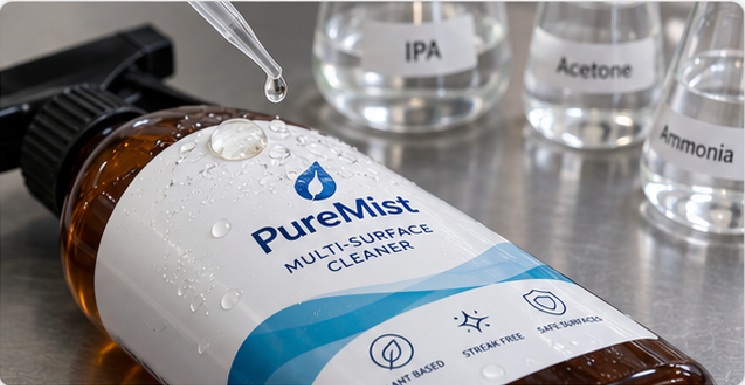
Cosmetics, supplements, automotive fluids, cleaners, and food products can expose labels to oil, alcohol, detergents, chemicals, or repeated wiping. The material, ink, varnish, laminate, adhesive, and edge design all influence the result. Philiton can select project tests for water, oil, alcohol, chemical exposure, rub, abrasion, or scratch resistance. Actual formulas or representative exposure conditions provide better evidence than a generic claim such as “waterproof” or “chemical resistant.”

Curved and Flexible Packaging

Small-diameter bottles, tapered containers, squeeze packs, tubes, and flexible pouches can force the label face to bend or move after application. Stiff constructions may pull at the edge, bridge a curve, wrinkle, or bubble. Philiton reviews label geometry, face-material flexibility, adhesive, corner shape, seam position, and application pressure. A slightly smaller label or more conformable construction can sometimes solve a failure more effectively than simply increasing adhesive strength.

Printing and Finishing Should Support the Launch Positioning

Philiton selects print and finishing routes around quantity, artwork count, visual target, material, repeatability, and later scale rather than adding decoration without a production reason.
Digital Printing

Digital Printing

Digital printing suits launch programs with smaller quantities, multiple SKUs, frequent artwork changes, photographic graphics, and variable versions. It removes conventional plate requirements and can shorten the path from approved artwork to printed labels when suitable materials are available. Philiton can use digital production for launch runs, sampling, multi-SKU programs, and replenishment while retaining the approved color, material, finish, and converting specifications for repeat orders.
Flexographic Printing

Flexographic Printing

Flexographic printing becomes attractive when stable SKUs move into larger or repeated roll volumes. It supports efficient roll-to-roll production, spot colors, broad material choices, and integration with converting or finishing. Philiton does not switch a launch SKU to flexographic printing only because one quantity threshold is reached; artwork, color system, material, finish, tooling, SKU count, repeat frequency, and required consistency are reviewed before a route change is approved.
White Ink and Clear Effects

White Ink and Clear Effects

Clear films, metallic substrates, and colored containers often need white ink to control opacity and color appearance. Philiton treats white as a separate production layer instead of assuming CMYK will look the same on every base material. White can sit under text, images, barcodes, or selected areas while other zones remain transparent or metallic. A physical sample helps confirm opacity, edge registration, color interaction, and the intended no-label look.
Foil Stamping

Foil Stamping

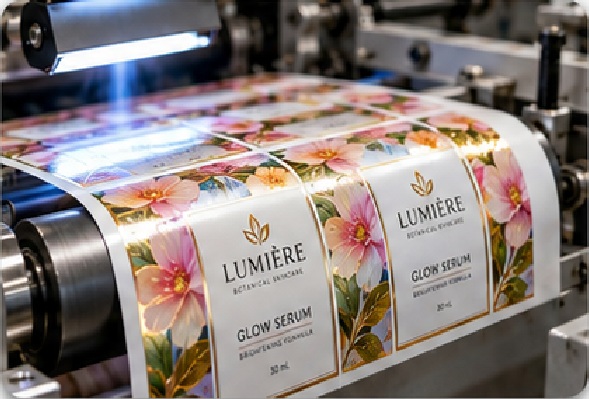
Foil can give a launch pack a strong premium signal when the design uses it selectively. Philiton can evaluate foil color, coverage, line thickness, registration, substrate, and surrounding print before sampling. Large solid foil areas, very fine reversed text, tight registration, or highly textured surfaces may need artwork changes. Foil adds fixed setup and process steps, so the visual value should justify the extra development and production work.
Embossing and Debossing

Embossing and Debossing

Embossing and debossing add tactile structure rather than relying only on printed color. Logo marks, borders, names, or selected graphics can gain depth when material thickness, artwork geometry, and tooling are suitable. Philiton reviews the interaction between print, foil, embossing, adhesive construction, die cutting, and final application. Production samples are useful for premium launches because screen previews cannot show actual relief, shadow, pressure marks, or tactile feel.
Holographic and Specialty Effects

Holographic and Specialty Effects

Holographic films, holographic laminations, specialty varnishes, spot effects, security printing, and selected UV treatments can create differentiation or functional value. Philiton confirms material availability, artwork layers, finish registration, barcode or QR zones, tooling, and supply constraints before production. Custom security holograms or specialized structures may carry additional development steps, so the launch schedule and first-run quantity should be planned around the chosen construction rather than added after artwork approval.

Freeze Artwork Details Before a Launch Run Is Released

Philiton checks production-critical artwork fields before printing so late changes do not create obsolete stock, mismatched SKUs, unreadable codes, or finishing errors.

Dieline and Finished Size

The label dieline defines the final shape, corner radius, cut position, and relationship between graphics and the edge. Philiton reviews finished size against the package and application method before release. A label can fit a flat artwork template yet fail on a tapered or small-diameter container. When an automatic applicator is involved, final dimensions also interact with liner width, gap, pitch, orientation, and sensor requirements.

Bleed and Safe Zone

Artwork must extend beyond the cut line where bleed is required, while important text, barcodes, borders, and legal copy need a safe distance from the trim. Philiton checks file setup before production so normal die-cut variation does not create white edges or clip critical content. Very thin borders close to the dieline are especially sensitive because even small movement becomes visually obvious on a finished label.

Color Targets

Philiton can work with CMYK, Pantone or spot-color targets, and physical references according to the selected print route. Material color, transparency, white ink, metallic reflection, lamination, varnish, and surface texture all influence final appearance. A Pantone target on white film should not be assumed to look identical on clear, kraft, metallic, or textured stock. The approved physical result is the strongest reference for repeat production.

White and Finish Layers

White ink, foil, embossing, spot varnish, security elements, cut paths, and variable-data zones should be separated clearly in the production file. Philiton checks layer names, overprint logic, knockouts, registration, and finish boundaries during prepress. Clear layer planning reduces interpretation during production and makes later artwork revisions safer because design changes can be compared against an already approved manufacturing structure.

Barcode and QR Zones

Codes need enough size, contrast, quiet zone, and distortion control for the intended scanner environment. Metallic or holographic effects behind a code may reduce contrast, while tight container curvature can distort symbol geometry. Philiton can review printability and verify code output according to the agreed inspection plan. Variable codes also require source-data control, uniqueness checks, restart rules, waste handling, and reprint logic when serialization is part of the launch.

Revision and Approval Status

Every release should identify the correct SKU, artwork revision, date, approval status, and production specification. Philiton keeps approved files separate from superseded versions so an earlier design does not re-enter production by mistake. A repeat order still needs a change check covering quantity, package, material, legal text, color, finish, roll format, and other requirements. Stable revision control becomes more valuable as the number of SKUs grows.

Develop Samples to Remove Uncertainty Before Bulk Production

Philiton uses different sample routes for appearance, material, finishing, function, and production release so each launch spends development effort where risk is highest.

Start With the Requirement and Choose the Right Sample Type

Sampling begins with the product and application, not with a machine. Philiton reviews package material, label size, quantity, SKU count, artwork status, desired finish, application method, service environment, compliance needs, and target launch date. The review determines whether the project needs a material swatch, digital print sample, production-style sample, finishing sample, security or RFID sample, or a more complete pre-production approval sample.

A simple visual check may only need a digital sample on the intended face material. A premium paper label with foil and embossing needs the actual finishing route to judge registration and tactile effect. A freezer label needs package-level adhesion and environmental validation. A roll label for an applicator needs winding, core, roll diameter, gap, pitch, liner, and sensor requirements confirmed before the bulk format is frozen. Choosing the right sample avoids spending time on a beautiful proof that does not test the real launch risk.

Philiton can also review available material alternatives before a formal sample is made. Early material comparison is useful when the design direction is still open or when specialty stocks carry supplier minimums. Development moves faster when the brief clearly states what must be proven: shelf appearance, color, opacity, adhesion, code readability, finishing, machine feeding, or a combination of those items.

Use Digital Samples for Speed, Production Samples for Process Proof

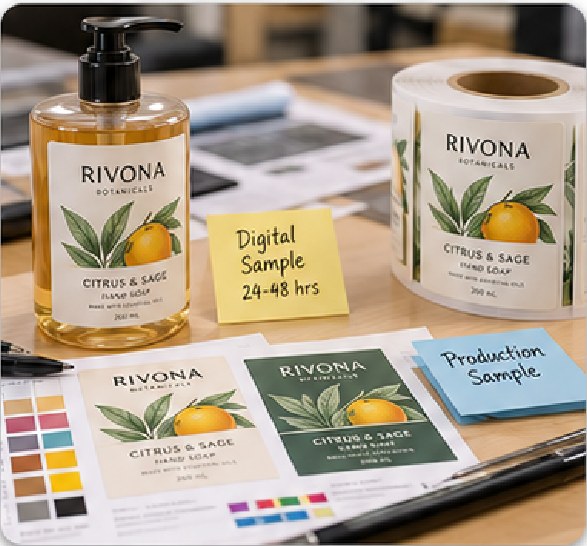
Straightforward digital samples using available materials can be handled on a rush basis as fast as 24-48 hours after artwork and specifications are confirmed, subject to machine load and project conditions. More complex samples take longer because special material sourcing, plate or tooling preparation, foil, embossing, holographic structures, security elements, RFID inlays, testing, or outside processes may be required. Philiton confirms the sample route and schedule before work starts rather than applying one lead time to every label.

Digital samples are useful for graphics, size, color direction, multi-SKU review, and early market presentation. They can expose copy errors, version issues, or basic layout problems before higher-cost finishing begins. Production-style samples become more important when final appearance depends on the real print method, tooling, finish registration, adhesive, roll construction, or functional performance.

The sample plan should match the decision still open. If color is approved but adhesive is not, the next sample should focus on the package and bonding conditions instead of repeating a full visual review. Philiton keeps the development path tied to unresolved risks so revisions have a clear purpose and approval can move toward production release. Sample records should also identify the artwork revision, material used, finish sequence, and date, so later feedback refers to the correct physical version rather than a photo or an earlier prototype that no longer matches the release direction.

Approve a Controlled Reference Before Production Release

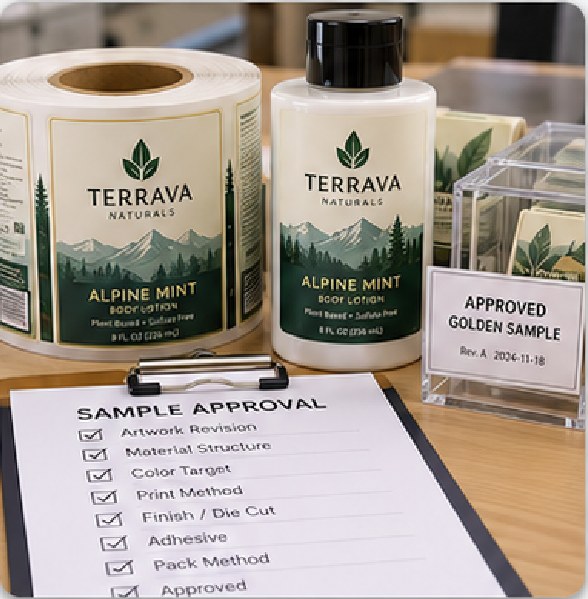
A launch sample becomes useful only when approval is linked to a defined specification. Philiton records the approved artwork revision, material structure, adhesive direction, print method, color target, white ink, finishing, die cut, roll format, packing method, and any agreed test or inspection requirement. Stable programs can retain an approved reference or golden sample so later batches are compared against a known physical outcome rather than memory or screenshots.

Approval should also record what remains project-dependent. A brand may approve visual appearance while waiting for final legal copy, a retailer barcode, or the co-packer’s roll specification. Philiton separates those open items from finished approvals so production is not released prematurely. When the final specification changes after sampling, the team decides whether the change is low risk or whether a new sample, test, or production check is needed.

Once the release package is complete, production receives the approved version rather than the full history of rejected alternatives. That handoff reduces version confusion during printing and converting. The same controlled reference supports repeat orders, especially when a launch grows from a few thousand labels into regular replenishment across several SKUs. When several SKUs share one construction, Philiton can keep common material and roll specifications together while maintaining separate approved artwork and quantities, making later replenishment easier to schedule without weakening version control.

Plan First-Run Quantity by SKU, Not Total Alone

Philiton reviews launch quantity together with SKU structure, material, tooling, finishing, forecast confidence, and repeat timing so opening inventory remains controlled without creating avoidable reorders.

Use Around 500 Pieces as a Starting Reference

For many standard custom label and sticker projects, Philiton can start from around 500 pieces per design or SKU. The actual minimum can change with material availability, special adhesive, foil or emboss tooling, custom holographic work, RFID inlays, security structures, or supplier minimums. A first-run decision should therefore begin with the launch structure and not treat one MOQ figure as a rule for every product.

Separate Total Volume From SKU Volume

An order of 12,000 labels could mean one SKU at 12,000 pieces, six SKUs at 2,000 each, or twelve SKUs at 1,000 each. File control, setup, color changes, finishing, QC identification, roll counts, and carton marking all increase as SKU complexity rises. Philiton prices and plans the actual mix so a multi-SKU launch is not compared incorrectly with a single-artwork high-volume order.

Standardize Shared Specifications

Multi-SKU launches become easier to manage when variants share the same size, material, adhesive, core, roll direction, liner, finishing platform, and packing logic. Artwork, flavor, scent, color, language, or variable data can then change without turning every SKU into a separate engineering project. Philiton reviews the SKU matrix for common elements that can stay fixed while still preserving clear identification and per-SKU approval.

Set a Reorder Trigger Before Launch

Opening inventory should be paired with a replenishment plan. Philiton can retain approved artwork, material, tooling, roll configuration, packing rules, and reference samples for repeat orders. The brand team can then set a reorder trigger based on sell-through, production consumption, co-packer inventory, or retailer demand. If a SKU grows quickly, the print route can be reviewed before the next order instead of waiting until stock is nearly depleted.

Build the Label Schedule Backward From the Launch Date

Philiton connects artwork, sampling, production, QC, packing, and freight milestones so the label does not become the final unresolved item before filling or market release.

Confirm the Launch Brief

Start with the target launch date, packing date, product category, package surface, label size, SKU count, quantity, artwork status, finish direction, application method, and destination. Philiton uses the brief to identify missing decisions before quoting a timeline. A date without a defined material, finish, and approval path is not a reliable production schedule, especially when special sourcing or new tooling may be involved.

Review Artwork and Structure

Prepress review should happen before sample production, not after. Philiton checks dieline, size, bleed, safe zone, color, white ink, finishing layers, code zones, revision identity, and variable-data logic. At the same stage, material, adhesive, liner, roll or sheet format, and application conditions are reviewed. Early alignment reduces the chance that a sample is rejected for a production issue that could have been identified from the brief.

Sample the Highest-Risk Items

The sample route should prove what remains uncertain. A simple launch may need a digital printed sample; a premium label may need foil or emboss proof; a cold-storage label may need package testing; an automatic roll label may need equipment specifications confirmed. Straightforward digital samples can sometimes move on a 24-48 hour rush path after requirements are complete, while complex work is scheduled according to the actual process sequence.

Freeze Approval for Production

Bulk production begins after the required artwork, material, color, finish, roll format, quantity, and packing approvals are closed. Philiton records the production revision and any approved reference sample. Open regulatory copy, missing barcode data, undecided roll direction, or unconfirmed package material can delay release even when the graphic design looks finished. A disciplined approval gate protects both launch timing and obsolete-stock risk.

Produce, Inspect, and Pack by SKU

Printing, finishing, die cutting, slitting, rewinding, inspection, and packing follow the released specification. Multi-SKU orders are identified through the production and packing stages so rolls, sheets, or individual labels remain traceable to the correct version and quantity. QC points are selected according to project risk, including color, dimensions, adhesion, surface durability, barcode or QR, environmental checks, or RFID verification where relevant.

Choose Freight From Deadline and Shipment Size

Philiton can arrange courier, air freight, or sea freight according to urgency, destination, shipment size, and agreed commercial terms. Direct delivery to a warehouse or fulfillment center can be planned when receiving rules, carton or pallet labels, appointments, and customs information are provided. Freight planning belongs in the launch schedule early enough to avoid choosing an expensive transport mode only because artwork or sample approval finished late.

Use Digital and Flexographic Printing at the Right Stage

Philiton can keep a stable product specification while changing the most efficient print route as quantity, SKU mix, finishing, and reorder behavior become clearer.

Decision FactorDigital PrintingFlexographic Printing
Launch quantityStrong fit for samples, short runs, and flexible opening inventoryStronger fit when stable roll volumes justify setup
Multi-SKUEfficient for many artworks using a shared constructionEfficient when artwork mix and production plan are stable
Artwork changesLower friction for revisions and version updatesPlate and setup changes require more planning
ColorStrong CMYK and version flexibility; spot targets reviewed by processStrong repeat spot-color and large-roll production capability
FinishingCan combine with selected foil, varnish, lamination, die cutting, and other stepsCan integrate roll-to-roll finishing and converting efficiently
Unit economicsAttractive before long-run setup is justifiedUnit cost becomes stronger as stable volume increases
Scale-up decisionCan remain the best route for long-tail SKUsOften reviewed for hero SKUs with larger repeat demand

Control Production From Approved File to Finished Roll

Philiton handles core converting and manufacturing steps through its production system, while base labelstocks, films, papers, adhesives, foils, and specialty substrates are sourced to project requirements.

Prepress Turns Approved Artwork Into a Production File

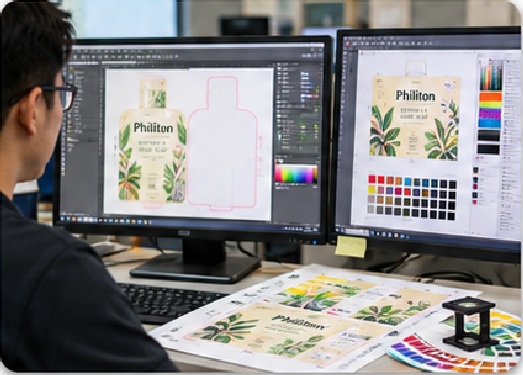
Production starts with controlled information. Philiton checks the released artwork against the approved dieline, size, SKU identity, color targets, white ink, foil or emboss layers, variable data, barcode or QR areas, and revision status. Print-ready files are prepared for the selected digital, flexographic, screen, UV, variable-data, or specialty process rather than sending the same artwork blindly to every machine.

Prepress also connects design choices to manufacturing tolerances. Fine reversed text, tight borders, very small foil details, clear-film opacity, metallic windows, die-cut position, and code zones can all require adjustment before printing. For multi-SKU programs, common dimensions and structures are separated from artwork-specific elements so every version is released against the correct quantity and production route.

Philiton was founded in 2016 and operates manufacturing in Shenzhen and Dongguan. The wider manufacturing system covers more than 12,000 ㎡ and employs more than 200 people, including 91 technical, skilled production, and quality personnel. Those resources support parallel artwork, printing, finishing, inspection, testing, and repeat-order work without turning a launch program into a purely outsourced coordination exercise. Prepress files, production instructions, and approval references move forward together, so the released specification can be checked again when artwork, quantities, or manufacturing routes change on later orders.

Printing and Finishing Follow the Approved Construction

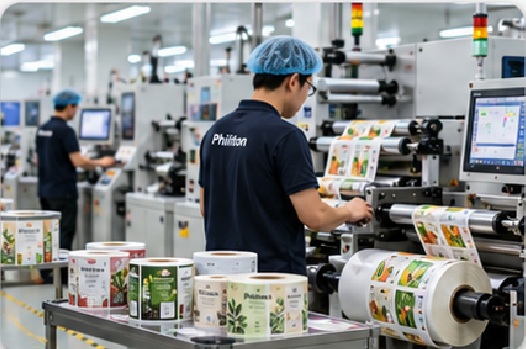
Philiton selects digital, flexographic, letterpress, screen, UV, variable-data, and related processes according to material, quantity, graphics, color, finish, and repeat needs. Printing is only one stage. Launch labels may continue through white ink, varnish, lamination, foil, embossing, debossing, holographic effects, coating, security features, or other approved finishing before the final label shape is created.

Each added process creates another control point. Foil needs position and coverage checks. Embossing requires tooling and registration. Lamination changes surface appearance and durability. Variable data requires source-data control and verification. Holographic or security work may need stricter material, waste, or confidentiality handling. Philiton keeps the production route tied to the released specification so a decorative feature is not substituted simply because another material or process is easier to run.

When launch quantities grow, the team can review whether a different print route improves economics without changing the approved appearance or function. A route change is evaluated against material, ink system, color, white ink, finishing, tooling, die cutting, roll format, and reference sample before being adopted for repeat supply. First-article checks are especially useful after a route or tooling change because they confirm the new setup still matches the approved visual and functional target before the full repeat quantity is completed.

Converting Creates the Finished Format the Packing Line Uses

After printing and finishing, labels move through die cutting, waste stripping, slitting, rewinding, inspection, sorting, and packing according to the required delivery format. Die cutting controls final shape, corner radius, gap, pitch, and liner integrity. Slitting and rewinding control roll width, direction, diameter, tension, core, and quantity per roll. Sheet or individual formats follow their own cutting and packing rules.

Automatic or semi-automatic labeling projects receive additional roll-spec review. Philiton confirms label size, roll direction, inside or outside wound construction, core, maximum roll diameter, gap or pitch, liner width, number across, perforation or black mark, and sensor needs before mass production. Those fields matter because a visually correct label can still stop a packaging line if the roll cannot feed or index correctly.

Final inspection and packing connect the physical label back to the project record. SKU, quantity, batch, roll or pack identity, and carton marks can be controlled according to the order. Repeat production then begins from retained specifications and approved references rather than rebuilding the entire launch setup. For split deliveries, co-packer shipments, or warehouse programs, packing instructions can be released with the same production package so the correct SKU and roll configuration reach the intended receiving point without a separate interpretation step at dispatch.

Test the Risks That Can Damage a New Launch

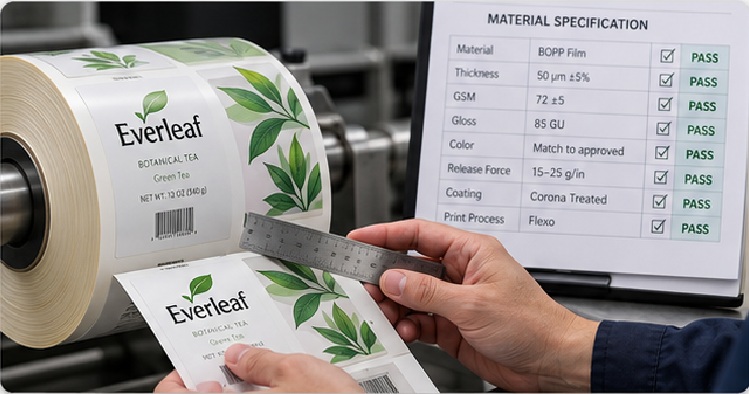
Philiton has established 25 testing paths in its quality fact base: 23 handled in-house and UV aging plus outdoor weathering handled through external testing routes.
Incoming Material Checks

Incoming Material Checks

Incoming control can compare material identity, thickness, GSM, color, gloss, release behavior, and other agreed characteristics before a launch batch enters production. Material documentation alone does not prove that the received roll matches the approved construction. Philiton links incoming checks to the project specification so changes in supplier, grade, coating, adhesive, or liner can be identified before they become printed finished stock.
Color Control

Color Control

Color is reviewed against the approved target, chosen material, print route, white ink, laminate, varnish, and surface finish. Philiton uses production references and color measurement where agreed for critical brand colors. Clear, kraft, metallic, and textured materials can shift visual appearance even with the same artwork. A physical approved sample remains especially valuable when the launch identity depends on a narrow color or finish expectation.
Dimension and Die Cut

Dimension and Die Cut

Finished size, shape, cut position, gap, pitch, liner condition, and related converting details influence both appearance and application. Philiton checks die-cut output against the approved specification and the delivery format. Tight borders, small corner radii, unusual shapes, narrow gaps, or automatic applicator requirements receive additional attention because converting variation can affect label release, sensor indexing, visual alignment, or high-speed application.
Adhesion and Release

Adhesion and Release

Peel adhesion, loop tack, shear, holding power, and release-force testing can be selected according to the label construction and application risk. Those tests help evaluate whether a label grabs the surface, stays bonded, creeps under load, or releases from the liner correctly. Lab data should still be connected to the real package because bottle radius, contamination, surface energy, temperature, pressure, and dwell time can change field performance.
Rub and Abrasion

Rub and Abrasion

Printed ink, foil, varnish, laminate, and exposed surfaces can be damaged by packing lines, cartons, transport, retail handling, or repeated wiping. Philiton can use rub, abrasion, or scratch testing to compare a launch construction against the intended use. Protective finishing is selected around the actual risk; adding laminate everywhere may increase cost or alter appearance when a simpler varnish would meet the handling requirement.
Water, Oil, Alcohol, Chemicals

Water, Oil, Alcohol, Chemicals

Exposure testing can be selected for products that face condensation, oils, alcohol, cleaners, chemicals, or repeated contact during use. Philiton evaluates the combined label system rather than assuming the face material alone determines resistance. Ink adhesion, foil, coating, laminate edges, adhesive, and package surface can each create failure points. Representative liquids or defined test conditions should be agreed when a claim is important to release.
Barcode and QR Verification

Barcode and QR Verification

A code should be verified for the intended print and scanning environment, not judged only by one successful phone scan. Philiton can check barcode or QR output for contrast, edges, quiet zones, decoding, damage, variable-data correctness, and related print-quality factors. Curved packs, reflective substrates, metallic effects, small code sizes, or poor color contrast are reviewed before volume production when the launch relies on retail scanning or traceability.
Environmental and RFID Checks

Environmental and RFID Checks

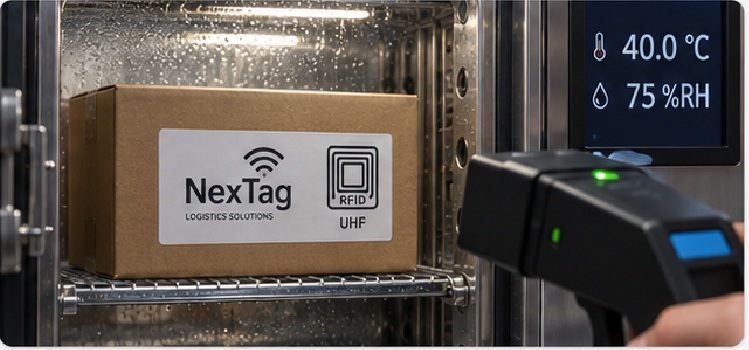
Temperature, humidity, high-temperature, low-temperature, freezer, UV-aging, outdoor-weathering, and RFID testing paths are selected according to project needs. UV aging and outdoor weathering use external routes in Philiton’s current testing structure, while other listed tests have internal paths. RFID programs can include read/write and encoding verification, but actual performance still depends on inlay, frequency, product material, metal or liquid proximity, installation position, and reader environment.

Keep Compliance Evidence Tied to the Exact Launch Construction

Philiton supports controlled manufacturing, material documentation, testing coordination, and approved regulatory artwork without turning project-specific evidence into blanket claims for every label.
Approved Regulatory Content Stays Under Version Control

Approved Regulatory Content Stays Under Version Control

Philiton can reproduce approved ingredient lists, warnings, instructions, certification marks, barcodes, UDI or traceability content, recycling marks, multilingual text, and other regulated information when the brand supplies the correct legal content and authorization. Prepress checks focus on printability, legibility, layer structure, size, and faithful reproduction. Philiton does not independently rewrite legal meaning unless the scope specifically includes an agreed artwork service and the responsible party approves the final result. Market obligations depend on product category, destination, contact condition, material structure, and the legal role of the brand, manufacturer, importer, responsible person, or other regulated entity. Food packaging, cosmetics, supplements, chemicals, children’s products, electronics, and medical-related projects can carry very different evidence requirements. A label used only on an outer package also differs from a label with direct product or food contact. Philiton therefore records the target market and project requirements, manufactures against the approved artwork and specification, and supports document or testing requests linked to the actual construction. Final legal labeling obligations and market authorization remain with the responsible legal party. That boundary protects the launch from a common mistake: treating a printer’s production capability as automatic approval for every claim, market, or product category. Philiton can still help production teams flag obvious printability issues, missing production layers, unreadable small text, or conflicts between decoration and mandatory information before a file is released.
Material Documents and Test Reports Must Match the Material Used

Material Documents and Test Reports Must Match the Material Used

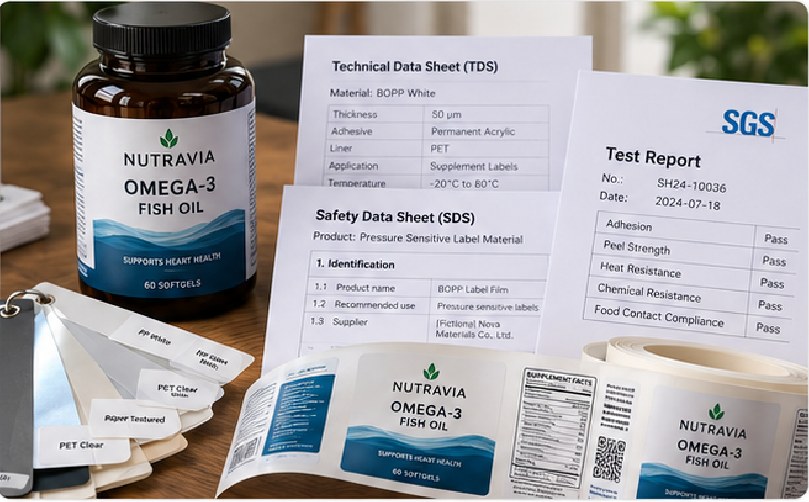
Supplier declarations, TDS, SDS, third-party reports, regulatory statements, and project test reports are only useful when they correspond to the material, supplier, formulation, construction, and intended use under review. Philiton can provide or arrange documentation for specified materials according to project requirements, and outside laboratories can be coordinated when a required test is not covered by the internal path or when independent evidence is requested. A report for one paper, film, adhesive, or coating should not be extended automatically to another grade or supplier. The same rule applies when a brand requests FSC-related materials, RoHS or REACH documentation, food-contact evidence, heavy-metals testing, CPSIA-related testing, Prop 65 evaluation, UL-related structures, or other regulated evidence. Scope, holder, material identity, market, and validity must be checked before any statement is used publicly or on the finished product. For sensitive launches, Philiton can also work under an NDA and restrict public use of branded samples or production photographs unless authorization is given. Approved artwork, material records, inspection information, and repeat-order specifications can then support supplier review while keeping confidential launch content separated from marketing use. When a material, supplier, formulation, destination market, or regulation changes, documentation should be reviewed again rather than carried forward automatically from the previous launch version.

Pack Launch Labels for Clear SKU Control and Line Use

Packing is treated as part of the finished specification. Philiton protects the label format, identifies SKUs and batches, and prepares shipments around receiving and application needs.

Protect Finished Rolls

Rolls are packed to reduce crushing, moisture exposure, telescoping, edge damage, and unwanted unwinding during handling and transport. Protection is adjusted to roll size, material, shipment method, and destination rather than using one fixed pack for every project. A damaged roll edge or distorted core can create feed problems even when the printed label itself is correct, so physical roll protection is part of production quality.

Separate SKUs Clearly

Multi-SKU launches need visible separation before cartons reach a warehouse, co-packer, or fulfillment center. Philiton can pack rolls, sheets, or individual labels by SKU and control the quantity assigned to each pack. SKU name, design code, size, quantity, batch, or other agreed identifiers can appear on pack or carton labels so receiving teams do not need to open multiple cartons to find the correct version.

Identify Roll Specifications

Automatic-application rolls can be marked with relevant information such as SKU, roll direction, core, quantity per roll, or other project fields when required. Philiton confirms roll construction before mass production so the packing label reflects the same specification used in converting. Clear roll identification is especially useful when several variants share identical dimensions and material but carry different artwork, languages, flavors, or variable-data programs.

Control Carton and Batch Marks

Outer cartons can identify PO, SKU, specification, quantity, carton number, batch, or destination according to receiving requirements. Philiton can align carton marks with packing lists and separate shipments when a launch is split between locations. Batch identification also helps later quality review because photos, roll numbers, and packing information can be connected back to the production record instead of relying only on the appearance of the finished label.

Combine Multiple SKUs Carefully

Several SKUs can ship together when each version is separately identified and packing quantities are controlled. Mixed-SKU carton or pallet rules can be set when a warehouse has defined receiving procedures. Philiton reviews whether combined packing saves freight and handling without increasing picking risk. High-volume hero SKUs may be separated from long-tail variants so replenishment, storage, and co-packer line staging remain easier to manage.

Ship to the Required Receiving Point

Courier, air freight, and sea freight can be arranged according to urgency, shipment size, destination, and agreed commercial terms. Direct delivery to a warehouse or fulfillment center can be planned when the receiving address, appointment rules, carton or pallet labels, and customs information are provided. Incoterms and responsibility for freight, customs, duties, and final delivery are confirmed in the quotation rather than assumed from the launch destination alone.

Representative Launch Cases From First Run to Repeat Supply

The following anonymized examples use representative order values to show how Philiton can structure launch projects without disclosing brand identities or confidential artwork.
United States Skincare Launch

United States Skincare Launch

A U.S. skincare brand prepared six serum SKUs in glass dropper bottles, with 2,000 labels per SKU and 12,000 labels for the opening run. Philiton reviewed bottle diameter, clear-film appearance, white-ink coverage, brand color, ingredient text, barcode areas, and roll format for the filling partner. Two sample rounds were used to refine opacity and text readability before approval. Digital production kept the six artworks flexible, while rolls were separated and carton-marked by SKU. Repeat planning retained the approved material, artwork revision, white-ink structure, and roll settings for later replenishment.
United Kingdom Chilled Food Launch

United Kingdom Chilled Food Launch

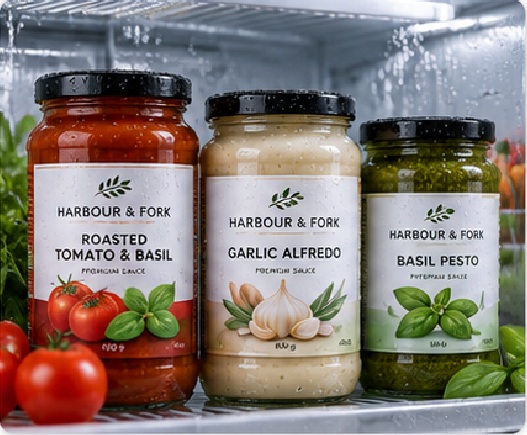
A U.K. food brand launched five chilled sauce flavors using 4,000 labels per flavor, for 20,000 labels in the first commercial order. The pack faced refrigeration, condensation, oily handling, and frequent contact during retail use. Philiton compared film and adhesive directions, then sampled the selected white film with matte protection on the actual jar. Color and barcode checks were completed before production. All five SKUs shared one size and material platform, which simplified converting and packing. Finished rolls were identified by flavor, quantity, and batch for direct use by the contract packer.
Australia Supplement Line Expansion

Australia Supplement Line Expansion

An Australian supplement brand introduced four products across two bottle sizes, ordering 6,000 labels per SKU for a total of 24,000 labels. The project required controlled small text, multiple color variants, QR codes, lot-related printing fields, and a finish that could withstand regular handling. Philiton reviewed the artwork matrix, bottle surfaces, label sizes, code zones, material, and roll specifications before production samples were approved. Digital printing supported the four artworks while the shared material and finish simplified production. Approved files, roll rules, and QC references were retained so higher-volume repeat orders could be reviewed without rebuilding the launch specification.

Frequently Asked Questions About New Product Launch Labels

For many standard custom label and sticker projects, the starting quantity is around 500 pieces per design or SKU. Actual MOQ depends on material availability, tooling, finishing, special adhesive, custom holographic work, RFID or security components, and the number of SKUs. Philiton reviews the whole launch mix before confirming the commercial minimum.

Start from the real packing plan, quantity per SKU, expected launch buffer, and reorder timing rather than a large sales forecast. A first order should protect the packing schedule without creating excessive obsolete stock if artwork or packaging changes. Philiton can review total quantity and per-SKU quantity together because one design at 12,000 pieces differs from twelve designs at 1,000 each.

Yes. Multi-SKU programs work best when variants share size, material, adhesive, liner, roll format, finishing, and packing logic. Artwork, flavor, scent, color, language, or variable data can remain different. Philiton separates files and quantities by SKU while looking for shared specifications that reduce unnecessary setup and make repeat ordering easier.

Yes. Material selection is based on the package surface, container geometry, moisture, oil, alcohol or chemical exposure, application temperature, service temperature, handling, desired life, visual target, and application method. Philiton can narrow the material family and arrange samples or testing before the final construction is released.

Straightforward digital samples using available materials can sometimes be handled on a 24-48 hour rush basis after artwork and specifications are confirmed. Complex finishing, special materials, tooling, security structures, RFID components, functional testing, or outside processes require more time. Philiton confirms the sample route and schedule against the actual project instead of applying one fixed lead time to every label.

Digital printing is often strong for samples, smaller runs, multiple SKUs, version changes, and variable artwork. Flexographic printing becomes attractive when stable repeat volume justifies setup and roll-to-roll efficiency. Philiton reviews material, colors, finishing, tooling, SKU mix, quantity, and reorder pattern before recommending a route or changing an approved SKU from digital to flexographic production.

Pantone or spot-color targets can be managed as controlled production references, and a physical color sample can also be used for visual or instrumental comparison where appropriate. Final appearance depends on the base material, transparency, white ink, ink system, laminate, varnish, and finish. The approved physical label is the strongest reference when repeat color matters.

Provide label size, roll direction, inside or outside wound requirement, core specification, maximum roll diameter, gap or pitch, liner width, number across, perforation or black-mark requirements, labels per roll, and available applicator information. Philiton reviews those fields before mass production so the finished roll matches the packing line rather than only the artwork.

Philiton can support material documentation, supplier declarations, project testing, and third-party testing coordination for specified materials and requirements. Evidence must match the actual material, construction, market, and intended use. The brand or responsible legal party confirms final labeling obligations and market authorization, while Philiton controls manufacturing against the approved artwork and specification.

Yes. Philiton is structured to support a progression from samples and launch runs into thousands, tens of thousands, and repeat mass-production programs. Approved artwork, material, finishing, tooling, roll format, packing rules, and reference samples can be retained. As demand grows, Philiton can review whether digital, flexographic, or another production route gives better economics while preserving the approved label outcome.

Send Your Launch Details for a Production-Ready Label Plan

A useful quotation starts with enough information to identify the right material, print route, sample type, quantity structure, finishing, roll format, and risk checks. Send the details already available; missing technical fields can be marked “Not sure” and reviewed by Philiton. For new launches, the most helpful starting information is the product and package, target launch date, label size or container dimensions, number of SKUs, opening quantity per SKU, application surface, expected exposure to water, oil, alcohol, cold or heat, desired visual finish, and whether labels are applied by hand or machine. Artwork can be uploaded in its current revision even when finishing layers or production notes still need review. If a co-packer or applicator is involved, include available roll specifications or equipment information. If the launch has regulated text, barcode, QR, RFID, security, or material-document requirements, include those at the quotation stage so sampling and production do not need to be restructured after visual approval. Philiton can then return a clearer manufacturing route instead of pricing an incomplete specification that is likely to change later.

Please include:

  • Product category and destination market
  • Package material, shape, and label area
  • Label size or dieline if available
  • Number of SKUs and quantity per SKU
  • Artwork files and current revision
  • Material or finish preference, if already selected
  • Hand or automatic application details
  • Target sample date, packing date, and launch date
  • Compliance, testing, barcode, QR, RFID, or security requirements
  • Delivery destination and preferred shipping method

For all inquiries, please feel free to reach out at:

Get In Touch

  • Our team will answer your inquiries within 12 hours.

  • Your information will be kept strictly confidential.

Get a Fast Quote for Custom Labels & Stickers

We will contact you within 24 Hours, please pay attention to the email with the suffix“@philiton.com”. 

For all inquiries, please feel free to reach out at:

Ask For A Quick Quote

We will contact you within 24 Hours, please pay attention to the email with the suffix“@philiton.com”. 

For all inquiries, please feel free to reach out at:

Get a Quote Today!

We will contact you within 24 Hours, please pay attention to the email with the suffix“@philiton.com”.